What Is Stress-Based Training in Krav Maga — and Why Does It Matter?
Stress-based training means practising Krav Maga technique while your heart is already elevated, your thinking is compressed, and the outcome is uncertain. It's the core of how the KMG curriculum is delivered at KMG North Shore Auckland — because skills learned only in calm conditions often aren't available when real pressure arrives.
Most people learn a technique, practise it slowly with a cooperative partner, get it right, and feel good about it. That feeling is real — and also incomplete. The question isn't whether you can perform a technique when you know what's coming and you're calm and rested. The question is whether you can perform it when you don't know what's coming, when your pulse is elevated, and when someone is actually trying to make it difficult.
That gap — between calm-condition competence and pressure-condition performance — is exactly what stress-based training closes. And it's the most important thing we do at KMG North Shore that most other training environments don't.
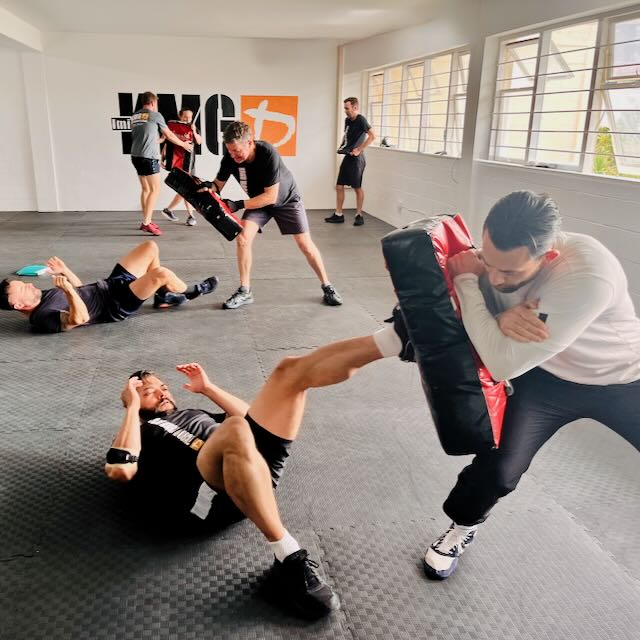
Scenario training at 47 Birkenhead Avenue, North Shore Auckland.
What your body actually does under genuine threat
Before getting into how training handles it, it's worth being clear about what happens physiologically when you face a real confrontation. Your sympathetic nervous system activates before you've made any conscious decision. Adrenaline floods your system. Heart rate spikes. Blood flow redirects to major muscle groups. Fine motor control — the precise hand movements that many techniques depend on — deteriorates significantly.
Your visual field narrows toward the perceived threat. Time distorts. Decision-making becomes compressed and less nuanced. These aren't signs of weakness or poor training — they're the human body doing exactly what it evolved to do under threat. The problem is that self-defence often requires clear thinking and precise technique in exactly the conditions that make both difficult.
This is what's sometimes called the stress inoculation problem: a skill that has only ever been practised in calm conditions has never been stress-tested, so there's no guarantee it will be available when the nervous system is fully activated. The fix isn't to learn better techniques. It's to train the techniques you already know under conditions that progressively mirror the ones you'll face.
How stress-based training works at KMG North Shore
At Birkenhead, stress exposure is progressive and deliberate — not random and not brutal. It's not about making training uncomfortable for its own sake. It's about systematically expanding the conditions under which your skills remain accessible.
Foundations first
Beginners start in a controlled, low-pressure environment. You learn what correct technique looks like, build initial muscle memory, and develop enough competence that you know what you're trying to do when pressure arrives. This isn't a shortcut — it's a prerequisite.
Introduce time constraints
Once basic competence exists, time pressure enters. Instead of practising until you get it right, you execute within a window. Mild, but effective — your brain starts processing under compressed conditions rather than unlimited time to think.
Add unpredictability
You stop knowing exactly what's coming. Attacks vary in angle, timing, and type. Rather than responding to a script, you start reading the situation and reacting. This is where genuine decision-making under pressure begins to develop.
Layer physical fatigue
Technique practice follows intense pad work or conditioning. Your heart rate is already elevated when the drill starts. This mirrors the physiological reality of a real confrontation — you rarely defend yourself from a rested baseline.
Complex scenarios
At more advanced levels: multiple attackers, restricted environments, different starting positions, verbal aggression, simulated weapon threats. The scenarios become rich enough that your nervous system can't tell them apart from situations that actually matter.
Instructor Aaron and Instructor Brad calibrate the pressure level in every session. Someone in their first month needs a very different challenge profile to someone who's been training for two years. The standard doesn't move — the approach to reaching it does.
The three types of stress we use in training
Real confrontations don't create just one kind of pressure. They create several simultaneously. Effective training addresses all three categories.
Physical
Elevated heart rate, muscular fatigue, shortened breath. Drills often follow conditioning work so your body is already working when technique practice begins. Continuous scenario sequences remove rest periods entirely.
Psychological
Unexpected attacks, verbal aggression, decision-making under time pressure, simultaneous threats requiring rapid prioritisation. This is often harder than physical stress for experienced athletes to manage.
Environmental
Restricted space, compromised positions (seated, on the ground, against a wall), variable lighting, holding objects. Confrontations don't start with you in an ideal stance with room to move.
A real threat will usually combine all three. Someone who only trains physical stress may maintain their technique when tired, but still freeze when the attack is unexpected. Training that addresses all three categories builds the kind of composure that holds up across the full profile of what a confrontation actually involves.
What this looks like in a class at Birkenhead
A concrete example is more useful than theory. Here's what a mid-level session might include: after a warm-up that elevates heart rates, the group works a specific defence technique against a single attack type — slowly, then at pace, corrections happening throughout. So far, standard.
Then the format changes. Training partners rotate without warning. The attack type is no longer announced. Then someone adds verbal aggression alongside the physical attack. Then students are told to start the drill from a seated position. Then the defence fails on purpose — intentionally resisted — requiring immediate adaptation to a follow-up technique rather than a clean reset.
By the end of that sequence, you've been defending with your heart rate up, with uncertain timing, with verbal distraction, from a compromised position, and with your first response not working. Your nervous system now has direct experience of functioning in all of those conditions simultaneously. That experience is what transfers into genuine capability.
Beginners don't get that full sequence in their first session. But the progression toward it starts immediately, and most students are surprised how quickly the initial discomfort of unpredictability starts to feel normal.
"I've been training for 5 years now and enjoy it as much as when I first started. A fun, friendly environment with great instructors. An awesome way to learn self-defence and gain confidence."
— Scott, KMG North Shore studentWhy this produces different outcomes than conventional martial arts
Most martial arts training happens in conditions that are more predictable and structured than real violence. Forms and kata develop excellent body mechanics but are rehearsed in calm, sequential order — the exact opposite of what confrontations involve. Point sparring is competitive and intense, but operates within rules and weight categories that don't exist when someone attacks you on the street.
This doesn't make traditional training worthless. Many people at KMG North Shore come from karate, BJJ, boxing, or taekwondo backgrounds and are excellent students. The foundation of body mechanics and physical conditioning transfers well. What often doesn't transfer is composure under the specific type of pressure that real threats create — because those training environments weren't designed to produce it.
Eyal Yanilov's approach to stress training within the KMG system specifically addresses this. The curriculum structure at KMG North Shore reflects that emphasis: every level of the KMG ladder from P1 onwards includes scenario-based work, not as an advanced option but as a core component of what the training is for. Stress inoculation isn't a module you graduate into — it's embedded from the start and scaled to where you are.
Is stress training safe — and is it right for beginners?
This is the question that stops some people from starting, so it's worth being direct: yes, stress-based training is safe for beginners — when it's structured correctly and supervised by qualified instructors.
The safety comes from the progression. A beginner at KMG North Shore is not thrown into multi-attacker scenarios in their second session. They build foundational technique in a supportive environment, and pressure is introduced only as their skills make it appropriate. The challenge level always sits just ahead of where you are — demanding enough to develop your capacity, never so far ahead that it reinforces helplessness or creates unnecessary risk.
Clear communication throughout training is part of the safety structure. If pressure becomes too much at any point, you can signal that immediately. Knowing you have that exit makes it easier to push harder, because the environment is genuinely controlled. Aaron and Brad are watching every student throughout every drill — adjusting intensity, coaching through difficulty, and recognising when someone is struggling productively versus struggling unproductively.
The other thing worth saying about beginners specifically: the nervousness people feel before starting is normal and appropriate. You're about to enter an environment that deliberately creates challenge. But the nervousness most people carry into their first session is significantly larger than what they actually encounter. The introduction to pressure in a well-run class is measured, explained, and supported in a way that tends to feel more manageable than expected.
The gains are also personal. Stress training builds mental toughness that carries well beyond the gym — more composure under workplace pressure, faster recovery from setbacks, a quieter confidence in situations that would previously have felt overwhelming. Many students describe these psychological shifts as the most valuable part of their training, sometimes more so than the self-defence skills themselves.
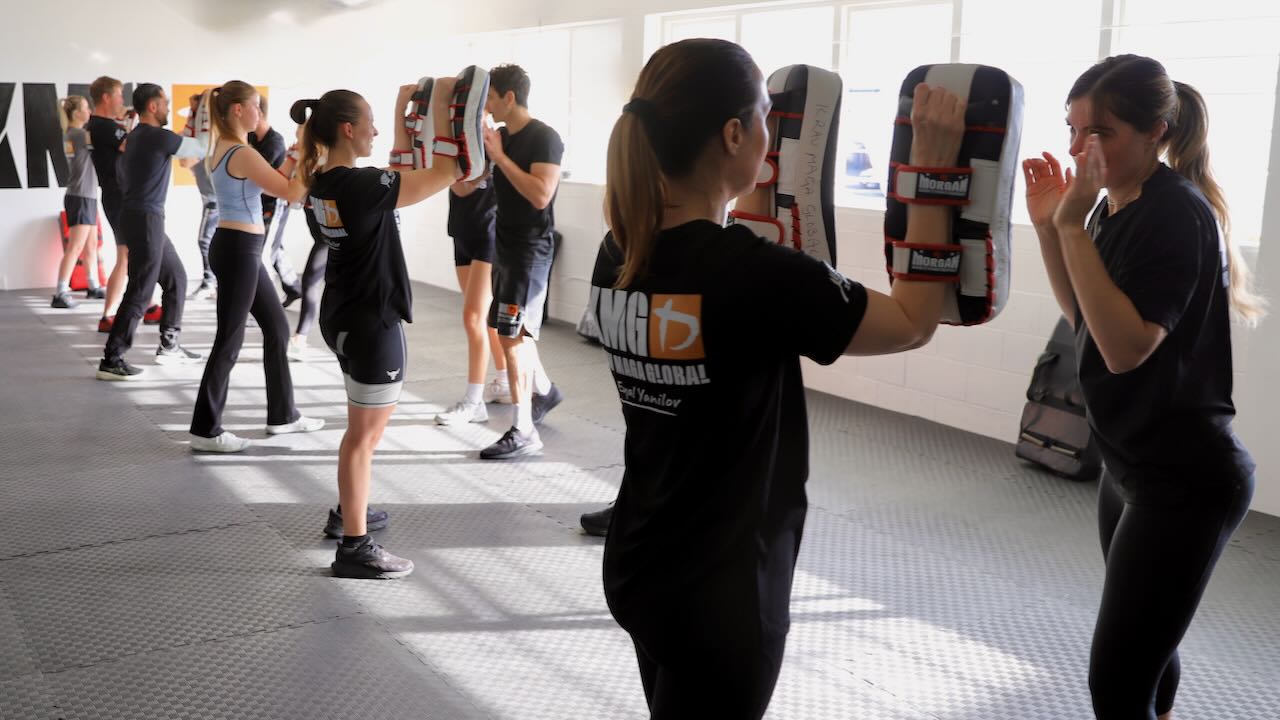
Training in action at KMG North Shore, 47 Birkenhead Avenue.
What People Ask About Stress-Based Training
Stress-based training means practising Krav Maga techniques while under controlled physical, psychological, and environmental pressure — elevated heart rate, unpredictable attack timing, verbal distraction, restricted space, or physical fatigue. The goal is to build skills that remain accessible when your nervous system is activated by genuine threat, not just in calm and predictable training conditions. At KMG North Shore, this approach is embedded across all levels of the curriculum, starting from the foundations and increasing in complexity as skills develop.
Yes — when structured correctly. Beginners at KMG North Shore start with foundational technique in a controlled, low-pressure environment, and stress elements are introduced progressively as competence develops. You're never put into advanced scenario drills before you've built the underlying skills to work with. The pressure always sits just ahead of where you are, expanding your capacity without overwhelming it. Instructor Aaron and Instructor Brad monitor every session and adjust challenge levels individually.
Sport sparring creates genuine physical and competitive pressure, but within rules and categories that don't exist in real confrontations. Stress training in Krav Maga focuses specifically on the type of pressure that characterises civilian threats — unpredictability, multiple simultaneous attackers, weapons, restricted environments, compromised starting positions, and no rules constraining how a threat unfolds. The goal isn't to win a contest — it's to develop composure and decision-making in the conditions that real self-defence actually involves.
Most students notice meaningful change within six to twelve weeks of consistent training. The heart rate still elevates in high-pressure drills — that doesn't go away — but it becomes less destabilising. Recovery between rounds improves. Decision-making under time pressure becomes faster and more reliable. The specific physiology that initially feels overwhelming starts to become familiar, which is the mechanism through which stress inoculation works. Consistency of training is the key variable — the adaptation is cumulative and requires regular exposure to develop.
Yes, and students at KMG North Shore consistently report this. The composure developed through pressure training surfaces in everyday situations — workplace conflicts, high-stakes conversations, unexpected setbacks. Your nervous system doesn't distinguish neatly between physical and non-physical pressure. The capacity to stay functional while stressed, make decisions quickly, and recover from mistakes transfers across contexts. Many students describe the psychological gains as equal to or greater than the self-defence skills themselves.
KMG North Shore trains at 47 Birkenhead Avenue, Birkenhead, Auckland 0626. Sessions run Saturday mornings (8:00–9:00am), Monday evenings (6:30–7:30pm), and Wednesday evenings (6:30–7:30pm). All beginner sessions welcome people with no prior martial arts experience. Free parking is available at Highbury Mall directly opposite. The trial class is the simplest way to experience what the training actually looks like — no commitment required beyond the first session.
See What Pressure Training Actually Feels Like
Book a trial session at Birkenhead. No prior experience needed — we'll start exactly where you are.
Book Your First Session47 Birkenhead Avenue · Sat 8am · Mon & Wed 6:30pm