From your first class to real capability.How we teach Krav Maga in Auckland
Plenty of our members walked in for their first session never having thrown a punch. With regular training, a few months later they move with purpose, read situations earlier, and carry a quiet confidence into the rest of their lives. You don't need to arrive confident or fit — we help you build from your starting point.
Krav Maga Auckland teaches the internationally recognised Krav Maga Global (KMG) curriculum in Birkenhead on Auckland's North Shore, led by head instructor Aaron Moore (KMG Expert 2). New members start with a trial class, then build practical self-defence skills through structured classes and KMG gradings.
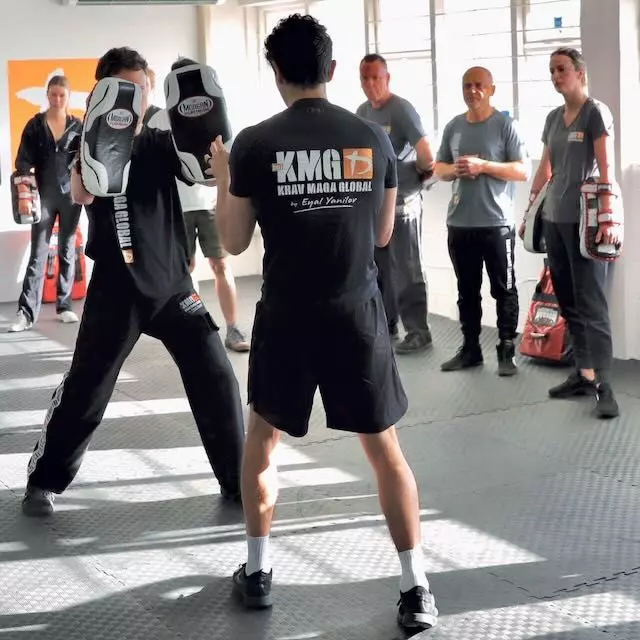
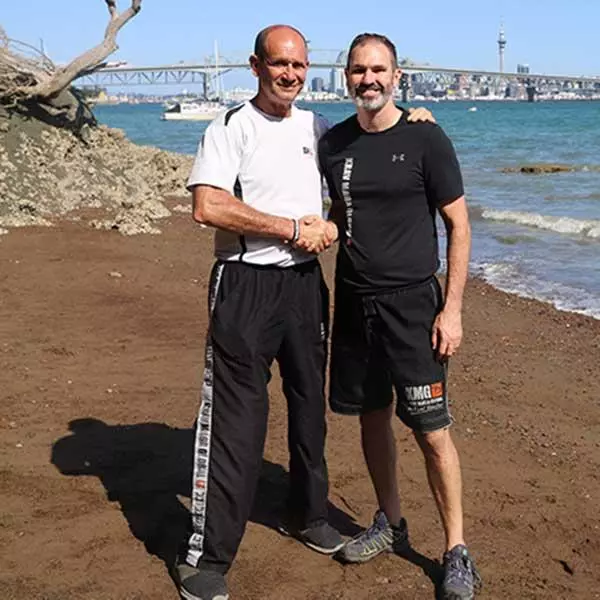
Who will be teaching you?
I've been teaching Krav Maga since 2010 — first in London, then back home on the North Shore, where I opened Krav Maga Auckland in 2015. Since then we've trained more than a thousand people, many arriving with no previous experience.
What happens next is the part I love. Skills click. Fitness builds. People start standing a little taller — at work, at home, walking to the car at night. And somewhere along the way, the group they train with becomes one of their favourite parts of the week.
That change comes from a proven system, taught step by step, in a room full of people who want you to do well. I still travel to train with Master Eyal Yanilov — 17 international camps and counting — because the standard I teach to has to be the real one.
If you're thinking about starting, come and see it for yourself. Brad or I will be on the mats with you.
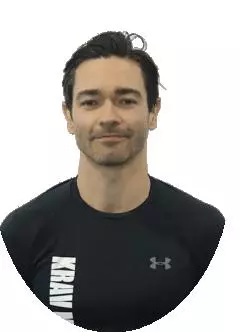
You'll also train with Instructor Brad
Brad is a KMG-certified instructor (Graduate Level 2) and coaches classes alongside me, so you'll get to know us both. Meet the instructors →
What training feels like, from your first class onward
Each stage is coached, so the challenge grows as you do.
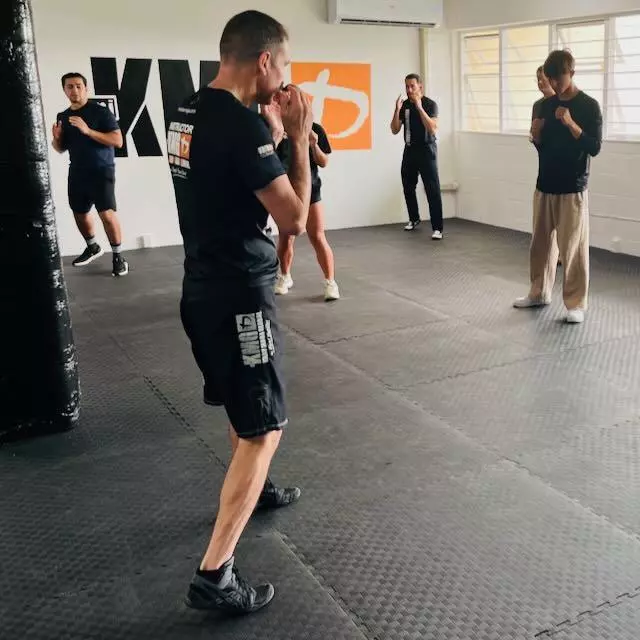
Your first class
You're partnered thoughtfully, shown each drill step by step, and coached by an instructor the whole way through. You'll leave having practised real techniques — and knowing exactly what this training feels like from the inside.
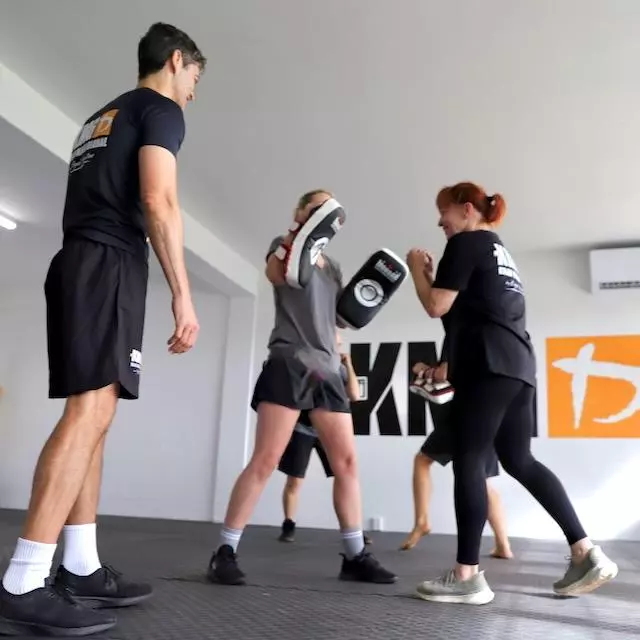
Foundations that stick
Your first month includes the Essentials programme alongside live classes. The aim is a working grasp of stance, movement, strikes and core defences early on, so later classes have something solid to build on.
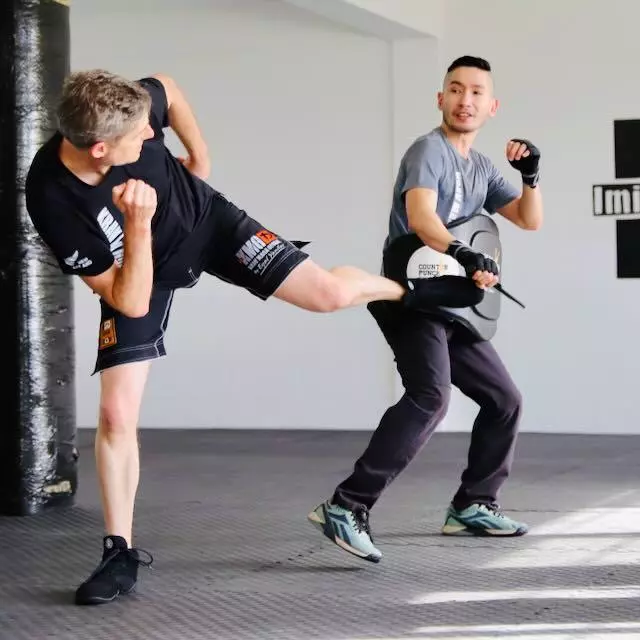
A real challenge, and goals to aim for
Drills become more demanding as your skills grow — longer combinations, weapon defences, and scenarios under pressure. For many members, that builds towards their first KMG grading.
What changes when you train here?
Training here builds more than technique. You develop mentally and physically at the same time — a capability most people never get the chance to build, and one that shows up well beyond the mats.
Practical skills you can rely on
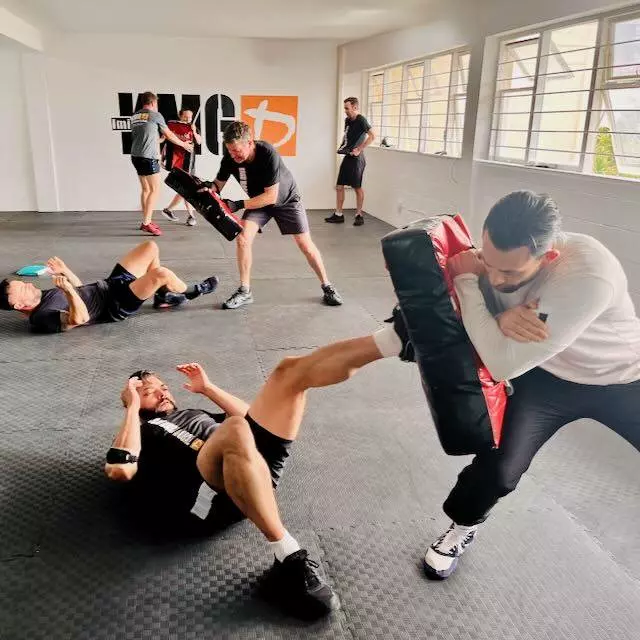
Real tactics for real situations — escaping grabs, defending strikes and weapons, getting up off the ground, and knowing when not to engage at all.
A stronger, more capable body
Fitness, power, coordination and resilience — built through training with a purpose beyond the workout, and scaled to where you're starting from.
A calmer, clearer mindset
Composure under pressure, faster decisions, and a quiet confidence. Members consistently describe it showing up at work, in relationships, and in how they handle stress generally.
Something challenging to be proud of
Setting a goal that genuinely stretches you — and reaching it. Each grade marks skills you've worked for, in a system few people ever take on.
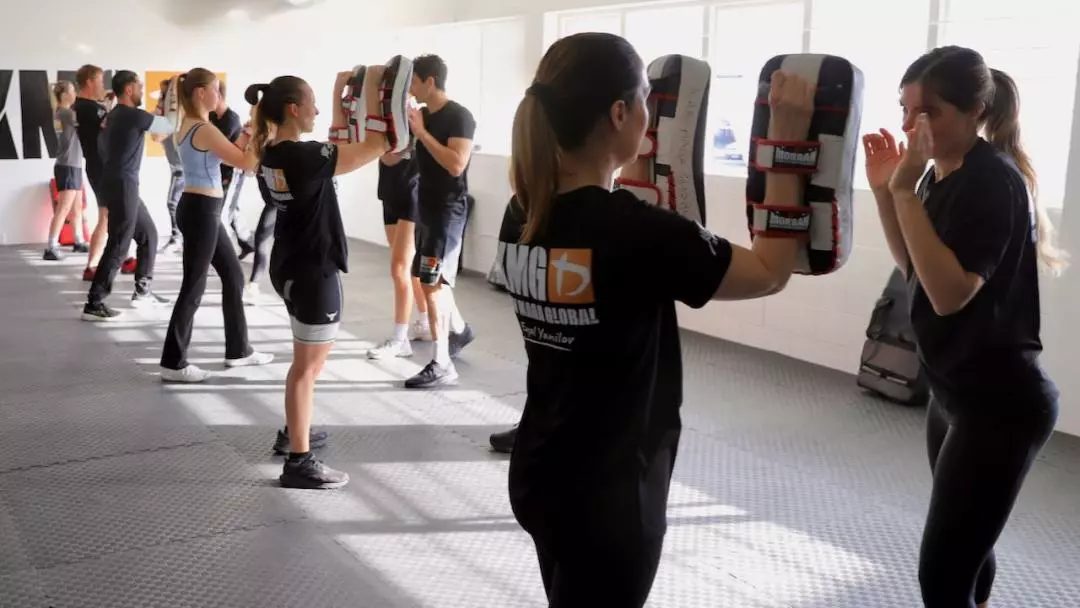
A group you'll look forward to seeing
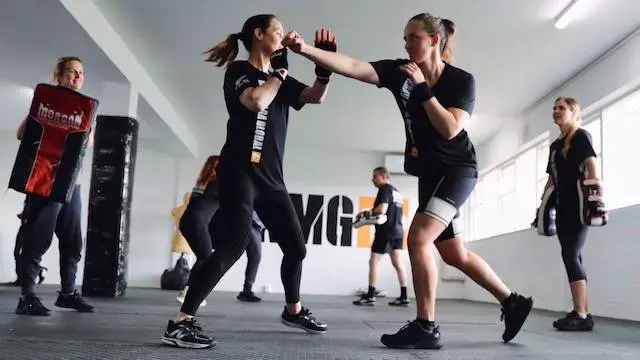
Most of the learning happens with a partner. Over the weeks you get to know the people you train with — holding pads for each other, working through the hard drills together, and noticing each other's progress.
Newer members are often paired with experienced ones who remember their own first classes. That shared effort is a big part of why people stay for years, not months.
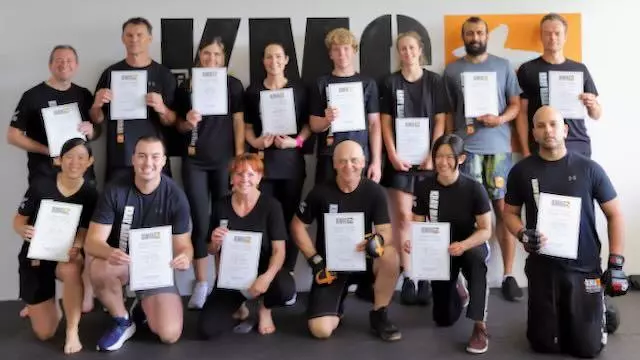
A goal worth working towards
For many members, grading day is one of the proudest moments of their training — the point where months of practice become something they've clearly earned.
Not random drills.
A structured system.
Krav Maga Global is the international organisation founded by Eyal Yanilov, the primary student of Imi Lichtenfeld, the founder of Krav Maga. The KMG curriculum is taught to civilians in 60+ countries, to the same international standard.
At Krav Maga Auckland, every class follows this curriculum. What you learn in your first session connects directly to what you'll develop over months and years — each technique family builds on the last.
The system covers strikes, defences, releases, ground defence, weapons awareness, and scenario-based decision-making — taught in a logical order from beginner through to advanced levels.
How we coach every class
These aren't values on a wall. They're the decisions behind how every class is planned and coached.
Real situations first
Every technique is taught in context — what situation it responds to, why it's structured the way it is, and how to choose the right response. Training is grounded in realistic scenarios, not isolated drills performed for their own sake.
Progressive by design
Beginners start at the foundations — stance, movement, awareness — and progress through technique families in a logical order. Intensity rises as skill and confidence develop, not before.
Avoidance before action
The goal is to avoid, de-escalate and disengage. Training covers situational awareness, boundary-setting, and reading a situation before it becomes physical. Physical techniques are the last resort, not the default.
Coached to the individual
Intensity, partner matching and technique progression are calibrated to you — not to the class average. New members build steadily; experienced members keep being stretched. Both train in the same session, differently.
Soft solutions and hard solutions — and knowing which to use
Krav Maga trains two kinds of response — and, just as importantly, the judgement to know which one a situation needs.
Soft solutions focus on awareness, positioning, verbal de-escalation, and creating distance. They're the first line of defence, and many situations can be resolved with them alone.
Hard solutions are for situations where avoidance hasn't worked and a physical response is necessary. The techniques are direct and practical, built on body mechanics and timing rather than raw size or strength — and practised under gradually increasing pressure.
Three principles shape every hard solution. Simplicity: techniques use large, natural movements that still work when adrenaline takes away fine motor control. Natural instinct: rather than overriding the reactions your body already makes — hands coming up, pulling away — the training refines them into effective responses. Simultaneous defence and attack: instead of block-then-strike, you defend and counter in one movement, so an attacker has as little time as possible to keep control.
Contact is introduced carefully. New members train with other beginners or with an experienced member mentoring the drill, and striking is developed on focus shields, "melons" and Thai pads rather than on training partners — with instructors explaining the right force for each piece of equipment before a drill starts. Weapon defences use rubber knives and foam sticks. As you progress, shin pads and gloves come in for light-contact work at higher levels.
Rather than competitive sparring, training builds toward controlled scenarios — multiple attackers, weapons, unpredictable situations — where "winning" means getting home. More on how contact works in training.
Soft solutions
- Situational awareness — reading an environment
- Positioning and distance management
- Verbal boundary-setting and de-escalation
- Disengaging safely and creating an exit
Hard solutions
- Strikes, releases, and escapes from grabs
- Defence against common attacks and weapons
- Ground defence and creating space to escape
- Striking power built on pads, not partners
- Proportional force — acting within New Zealand law
What members say about the journey
100+ five-star reviews — Google & Facebook
"I've never been to any martial art classes before and with a bit of nervousness I attended my first class. I was amazed how friendly but professional the instructors are — other students are just like you and me."
— Chris"As a woman of a smaller build I have found that these classes have strengthened me both physically and mentally. Anyone can learn from here — it is a positive, open and welcoming environment."
— Christine"I've been training for 5 years now and enjoy it as much as when I first started. A fun, friendly environment with great instructors. An awesome way to learn self-defence and gain confidence."
— ScottReal people, real situations
Everyone starts from a different place — size, fitness, experience. Training is adapted to where you are, and the people at Krav Maga Auckland reflect that range.
Starting from zero
No experience or fitness test required. Many members had never trained in any martial art or self-defence system before.
Women training for safety
Mixed regular classes and a dedicated Women's Self-Defence programme — both build real, practical skills for everyday situations.
Experienced martial artists
Krav Maga adds a practical self-defence framework to what you already know. See how Krav Maga compares with karate, BJJ, boxing, and MMA.
Frequently Asked Questions
What kind of Krav Maga is taught at Krav Maga Auckland?
Krav Maga Auckland teaches the Krav Maga Global (KMG) curriculum, the international system founded by Eyal Yanilov, the primary student of Krav Maga founder Imi Lichtenfeld. The same curriculum and grading standards are used in 60+ countries, and head instructor Aaron Moore has taught Krav Maga since 2010.
What are soft and hard solutions in Krav Maga?
Soft solutions are non-physical skills such as awareness, positioning, verbal de-escalation and creating distance, and they come first. Hard solutions are direct physical techniques for when avoidance hasn't worked. Krav Maga Auckland trains both, along with the judgement to choose between them.
Does training at Krav Maga Auckland involve sparring?
Competitive full-contact sparring isn't part of standard training. Striking power is built on pads and shields, weapon defences use rubber knives and foam sticks, and light-contact work with gloves and shin pads comes in at higher levels. Read more on how safety is handled in Krav Maga training.
What happens after I join Krav Maga Auckland?
You start with a trial class, then the four-week Essentials programme, included in your first month of membership, which pairs video and article lessons with live classes. There's also a guide for anyone nervous about starting Krav Maga.
The best way to understand the training is to feel it
One session tells you more than any page can. Book a trial class and meet the people you'd be training with — 47 Birkenhead Avenue, down the external stairs to the right of the Superette.
47 Birkenhead Avenue, Birkenhead, Auckland 0626 · 027 214 9461 · Full timetable and details