What Happens in Your First Krav Maga Class?
Your first Krav Maga class at Krav Maga Auckland in Birkenhead starts with a welcome from Aaron or Brad, a movement-based warm-up, and guided practice of basic stance, footwork and strikes. You train with an appropriately matched partner at a comfortable pace. Core sessions last about an hour. No martial arts experience or fitness test is required, and you are not expected to spar.
If you've never trained before, it helps to know exactly what happens — from the moment you walk in to the moment you leave.
This is how beginners are introduced to Krav Maga at Krav Maga Auckland in Birkenhead. Here's how the session is structured, from the first minute.
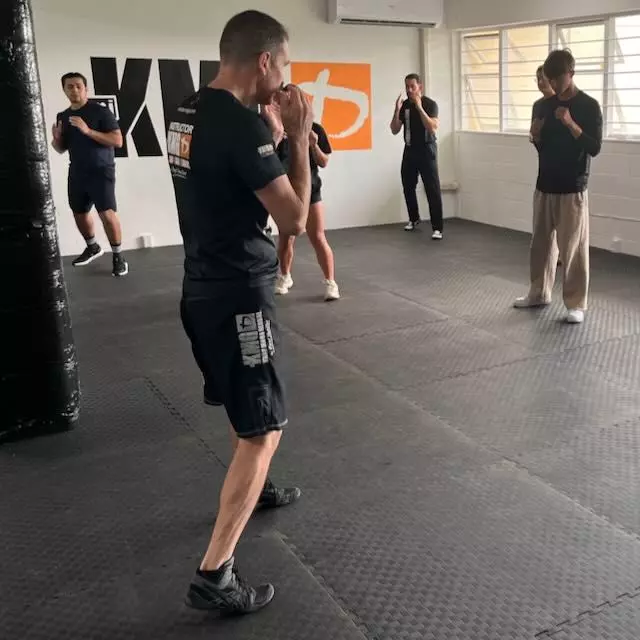
Instructor Aaron coaching beginners through stance work at Krav Maga Auckland.
What happens before the class even starts?
You'll be greeted by Instructor Aaron or Brad as soon as you arrive. There's no awkward sign-in desk moment — the instructors make a point of introducing themselves to anyone new before training begins.
You'll get a quick rundown of what the session covers and what to expect. If you have any injuries or concerns, this is the moment to mention them. The instructors adjust for individuals — that's standard, not an exception.
What if I'm nervous about starting Krav Maga?
Feeling nervous before your first class is common, and it's a reasonable response to trying something new. The instructors introduce themselves to anyone new before training starts, pair you thoughtfully, show each drill step by step and let you work at your own pace, so you won't be left to work things out alone.
Feeling awkward with unfamiliar movements is part of learning anything new, and instructors expect it. Nobody expects polish in your first session — just that you try, pay attention and keep going. If fitness is part of the worry, see the section on fitness below; you don't need to be fit to start.
"Everyone who walks in for the first time is nervous. The ones who've done martial arts before are nervous about looking like beginners again. The ones who've never trained are nervous about not keeping up."
— Instructor Aaron, Krav Maga AucklandHow does the class actually begin?
Every class starts with a warm-up — dynamic movement, not a static stretch routine. You'll move through footwork drills, light cardio, and mobility work that primes you for what's coming. It's active from the start, but nothing that leaves you gassed before the real training begins.
After the warm-up, the instructor introduces the session's focus. Beginner classes at Krav Maga Auckland are structured around the KMG curriculum — techniques are revisited and developed over the weeks, so each class connects to the wider curriculum rather than being a random set of drills.
What techniques will I learn in my first session?
Your first class focuses on the fundamentals: stance, movement, and your first strikes. This usually includes the fighting stance, basic footwork, and straight punches or palm strikes depending on the session plan.
You also begin learning how balance, positioning and efficient movement support your response. Awareness, creating distance and finding an exit matter alongside physical technique. These foundations are developed progressively rather than expecting you to handle a complex situation on day one.
By the end of the session, you'll have practised a few techniques in real repetitions — not just watched a demonstration. You leave having actually done something, not just observed it.
"I've never been to any martial art classes before and with a bit of nervousness I attended my first class. I was amazed how friendly but professional the instructors are — other students are just like you and me."
— Chris, Krav Maga Auckland memberDo I have to pair up with someone? What if I don't know anyone?
Yes — most Krav Maga training is done with a partner, and that's by design. Working with another person is what makes the techniques feel real. But the pairing process is relaxed — instructors help new people find a training partner, and the group is used to welcoming new people.
Beginners typically work with another beginner or an experienced member mentoring the drill. Aaron or Brad explains the task, checks how you are getting on and adjusts pace or complexity to suit you. Core classes include different experience levels; you are not expected to match an advanced student’s intensity.
When you join, the four-week Essentials onboarding programme supports your first live classes with videos and articles. It gives you a structured introduction alongside regular training.
How hard is the first class? Do I need to be fit?
The first class is challenging enough to be real training — but it's not designed to test your limits. Instructors pace beginner sessions well, and you work at your own level within the structure of the class.
Fitness helps, but it isn't a prerequisite. People at all fitness levels train at Krav Maga Auckland, and the training itself builds your conditioning over time. For more on what the physical demands actually look like, see How Intense Is Krav Maga Training for Beginners?
How does the class finish?
Sessions close with a cool-down and a debrief from the instructor. You'll hear what the techniques were designed for, how they connect to real situations, and what you'll be building on in the next class. It's brief but useful — it puts everything you just did in context.
After class there's usually time to ask questions and meet the people you'll be training with.
How are beginners introduced to Krav Maga training?
Beginners start with foundations that connect to the wider Krav Maga Global (KMG) curriculum. Each session has a clear focus, with explanation, demonstration, practice and feedback. You do not have to understand the whole system before your first class.
Stance, movement and balance
You learn how to stand and move while keeping your balance and options open. These foundations support later strikes, defences and escapes.
Awareness and choosing a response
Early training introduces reading your surroundings, managing distance and noticing an exit. Soft solutions include verbal boundaries, positioning and disengaging. Physical responses are developed for situations where avoiding contact has not worked. Learning when to act matters alongside learning how.
Basic strikes and defences
You practise a manageable selection of strikes and, depending on the session, introductory defences against common grabs or pushes. The instructor explains the situation each drill addresses. Technique families are revisited over time so you can build familiarity through repetition.
Is there contact or sparring in beginner training?
Beginner training includes controlled partner drills. Striking power is developed on focus shields and pads, with instructions on appropriate force. You are not expected to fight or take part in full-contact sparring in your first class. Challenge increases as your skills and confidence develop; sparring may be used selectively at higher levels. Read how contact and safety work in training for more detail.
How does Essentials support your first month?
A trial lets you experience a regular class before deciding whether to join. As part of membership, the four-week Essentials programme provides video and article-based onboarding alongside your first live classes. It helps you review the foundations between sessions and understand how the training fits together.
Essentials and ongoing classes follow the same KMG system. Your instructors help you connect the resources with what you practise on the mats. See our approach to coaching and individual progression for the wider picture.
What can I expect after the first class?
The first session is a starting point. With regular practice, unfamiliar movements become more familiar and your fitness, coordination and confidence can develop alongside your self-defence skills. Learning to apply those skills under increasing pressure takes repetition and time.
For many members, two sessions a week is a sustainable routine, although once a week can still build skills. You can explore a realistic timeline for building capability and how grading and progression work when you are ready. Your first class does not commit you to pursuing grades.
Where is my first class, and how do I book?
Training is at 47 Birkenhead Avenue, Birkenhead, Auckland 0626, on Auckland’s North Shore. Core sessions are Monday and Wednesday, 6:30–7:30pm, and Saturday, 8–9am. All three are open to beginners.
Book in advance so the instructors know you are coming. Use the trial booking page; for the full timetable, location and arrival information, see our self-defence classes in Auckland page. If you have a question before booking, call 027 214 9461.
What People Ask Before Their First Session
A first class at Krav Maga Auckland starts with a greeting from Instructor Aaron or Brad, followed by a movement-based warm-up. From there you'll work through fundamentals — stance, footwork, and basic strikes — then practise them in calibrated partner drills. The session closes with a cool-down and debrief. Total session time is around an hour. No experience or fitness test required.
That's common. Instructors meet new people before class, pair you thoughtfully and coach each drill step by step at your pace. Tell them if you're nervous or have any injuries, and they'll help you settle in.
Wear comfortable training gear — shorts or trackpants, a t-shirt, and training shoes or bare feet. There's no uniform required at Krav Maga Auckland. Avoid clothing with zips or hard buckles that could scratch a training partner. Bring water and a small towel. No special kit needed for your first session.
No. Your first class focuses on foundations, pad work and controlled partner drills. Full-contact sparring is not standard beginner training. Intensity and complexity develop progressively, with sparring used selectively at higher levels.
Classes at Krav Maga Auckland run for approximately one hour. That includes the warm-up, the main technique work, partner drills, and the cool-down debrief. It's a full hour of real training — not a lot of standing around.
Book your trial session in advance through the trial booking page. This lets the instructors know you are coming and helps them prepare for new attendees. The North Shore classes page has the full timetable and location details.
Book a trial in a regular Core class. You do not need prior experience. When you join, the four-week Essentials onboarding programme supports your live classes with videos and articles, helping you build the foundations progressively.
Core classes include beginners and experienced members. Instructors match partners appropriately and adjust drills to the individual. A beginner may work with another beginner or an experienced member mentoring the drill; you are not expected to perform at an advanced level.
KMG stands for Krav Maga Global. Its structured curriculum connects beginner foundations with later skills. Krav Maga Auckland follows this system, so stance, movement, awareness and basic techniques are developed progressively and revisited through regular practice.
Yes. You can begin at your current fitness level and build conditioning through training. Tell Aaron or Brad about any injuries or concerns before the session so they can help you work at an appropriate pace.
Krav Maga Auckland trains at 47 Birkenhead Avenue, Birkenhead, Auckland 0626. Core classes are Monday and Wednesday from 6:30–7:30pm and Saturday from 8–9am. All three welcome beginners. Book your session in advance.
Start with one session
Come to a trial class. Aaron or Brad will help you settle in, learn the foundations and find a pace that works for you.
Book a Trial Class47 Birkenhead Avenue, Birkenhead, Auckland 0626 · 027 214 9461