How Intense Is Krav Maga Training for Beginners?
Beginner Krav Maga training at Krav Maga Auckland is physically demanding but fully controlled, with calibrated partner drills and no full-contact sparring. Research commissioned by the American Council on Exercise rated Krav Maga moderate-to-vigorous intensity, averaging 616 calories burned per hour. Intensity scales with your ability, so you train real scenarios from day one.
The most common worry before a first class is that Krav Maga will be chaotic or aggressive — that because the system is built for real-world situations, the training must be punishing from day one.
The reality is the opposite. Effective self-defence training demands a high degree of control. The KMG curriculum is built to develop capability progressively — which means you build fitness and technique at the same time, starting from wherever you are right now.
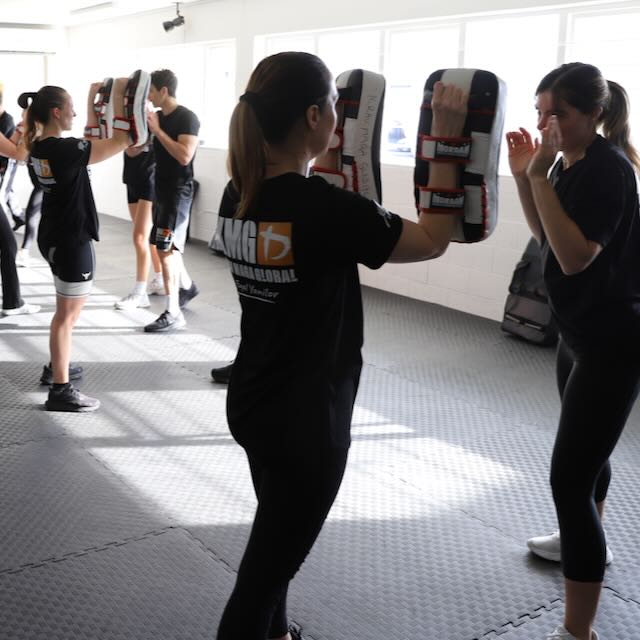
Controlled beginner training at Krav Maga Auckland, Birkenhead.
Is beginner Krav Maga training aggressive or dangerous?
No — beginner training at Krav Maga Auckland is controlled, supervised, and matched to your current ability at every stage. The Krav Maga Global curriculum was designed by Imi Lichtenfeld around the principle that self-defence techniques must work for regular people under real conditions — which means they need to be practised safely enough that they can actually be internalised and retained.
In a beginner class, there's no place for unchecked aggression or high-risk contact. Instructors break techniques into clear steps. Partners work together cooperatively — one person executes, the other assists. Contact is calibrated: light and controlled in early weeks, increasing gradually as coordination and confidence develop.
What you will find is that sessions are more physically demanding than most people expect — not because of aggression, but because of sustained movement, pad work, and the genuine effort of learning to coordinate your body in new ways. That physical challenge is real and intentional. The danger people imagine is not.
What does a typical beginner class actually look like?
Understanding the structure of a class removes most of the uncertainty that keeps people from starting. A standard 60-minute session at Krav Maga Auckland follows a consistent shape:
- 0–10 min Warm-up — movement patterns, joint mobility, light cardio to raise body temperature and prepare the nervous system. Nothing technical yet.
- 10–30 min Technique work — the session's focus technique, broken into components and drilled slowly with a partner. Instructor demos first; you copy the movement at controlled speed.
- 30–50 min Pad work and combinations — applying the technique with feedback from pads. This is where cardio demand increases. You control the pace — harder or lighter, faster or slower, based on how you feel.
- 50–60 min Cool-down — stretch, reflection on the technique, any questions. The atmosphere is calm, not competitive.
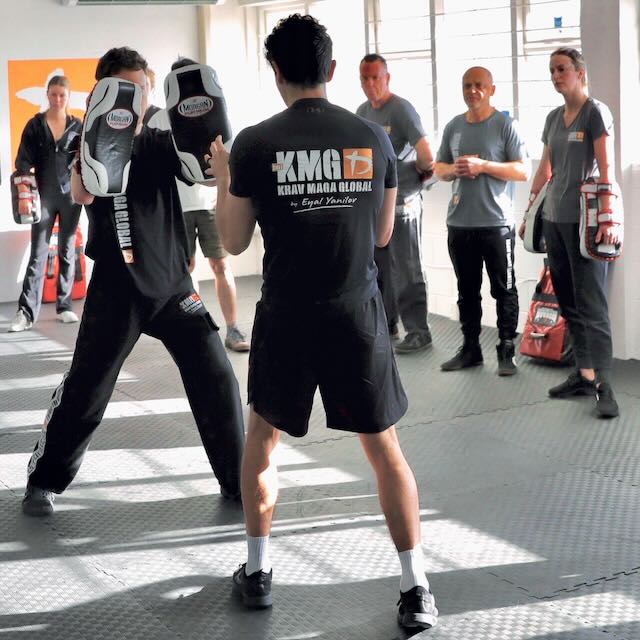
There is no surprise element. No one tests you or puts you on the spot. You know what's coming because the session structure is consistent — and that consistency is what lets people relax enough to actually learn.
How physically hard is it — and what does the research say?
Krav Maga sits in the moderate-to-vigorous intensity category — measurably harder than a typical gym session, but structured around technique rather than raw effort. In an independent study commissioned by the American Council on Exercise, participants burned an average of 616 calories per hour during Krav Maga training — well above the recommended range for improving body composition — while heart rate and perceived exertion placed the activity firmly in the moderate-to-vigorous zone. The researchers noted that the training met ACSM guidelines for improving cardiorespiratory fitness. Crucially, participants reported enjoying it, describing it as a challenging but engaging way to train.
For a beginner, that intensity isn't something you're expected to hit on day one. You train the same real scenarios from your first class, at a level of complexity and effort that matches your current ability. As your technique and coordination improve, you can put more power, speed and pace into every rep — and that's when sessions start to feel genuinely challenging in the way the ACE data describes.
How does intensity build as your skill develops?
From your first class at Krav Maga Auckland, you train the same real self-defence scenarios as everyone else — strikes, defences, chokes, grabs, and combinations — just at a level of complexity and effort that matches where you are right now. The curriculum doesn't hold beginners back from real content. It introduces that content through simpler versions first, and the training naturally becomes more demanding as your ability grows.
That progression happens on two dimensions simultaneously. The scenarios get more complex — single techniques become combinations, combinations become multi-step scenarios, and scenarios eventually include variables like multiple directions or different threat types. And the effort you can put into each rep increases too: as your technique improves and your body learns the movements, you can exert more power, work at higher speed, and push further into the cardio zone without sacrificing form.
The Practitioner 1 level — reached after roughly 40 classes over four to six months of twice-weekly training — covers the core scenarios most people want to be prepared for. By that point, most students are working at an intensity that would have been genuinely overwhelming on day one. Not because the drills changed — but because they did.
Training hundreds of people over more than a decade at Krav Maga Auckland has produced a consistent observation: students who start with solid fundamentals and build intensity progressively maintain good technique as the training gets harder. Students who try to go hard too early often lock in poor mechanics under pressure — mechanics that become increasingly difficult to correct. The fundamentals aren't the beginner phase you pass through. They're what everything else runs on. Getting them right first is what makes the harder training later actually work.
What does "intensity" actually mean in Krav Maga — and why the distinction matters
There are two completely different things people mean when they talk about training intensity, and conflating them causes a lot of unnecessary confusion — and some genuinely bad advice.
Aggression and contact intensity refers to how hard people physically engage with each other — uncontrolled strikes, high-force partner contact, training environments where getting hurt is treated as proof the training is real. Some schools position this as authenticity. The reality is that a highly aggressive, high-contact environment puts off most beginners and produces injury. Neither outcome serves the goal of building self-defence capability across a broad population of ordinary adults.
Cardio and muscular intensity is something else entirely. Sustained movement, repeated pad combinations, timed rounds, scenario drills that push your heart rate and challenge your endurance — this is what physically demanding Krav Maga training actually looks like. And you can achieve very high levels of this kind of intensity through pad work alone, which is both safe for you and safe for your training partner. Pads let you hit with real power and real speed without either person absorbing the impact directly. That's not a compromise — it's what makes genuinely hard training sustainable session after session, week after week.
The instructor experience behind this approach matters. Having trained hundreds of people over more than a decade, the pattern is consistent: students who go hard from the start without solid fundamentals often lock in poor technique under pressure — and that technique is very difficult to correct later. High contact and aggression early doesn't build real capability. It builds habits that look like intensity and function like noise. Students who build fundamentals correctly and progressively increase effort maintain their technique as the pressure rises. That's what transfers to a real situation.
At Krav Maga Auckland, the training is physically demanding in the productive sense and controlled in the destructive one. You will go hard — on pads, in drills, across scenarios. The people in our classes come from all walks of life and none of them want to go home injured. Organisations that claim realism requires high-contact aggression have the training records to show for it. We don't train that way, and it shows in who stays and what they develop.
If you're still unsure whether this is the right fit, What Happens in Your First Krav Maga Class takes you through exactly what to expect on day one.
What makes training manageable for complete beginners?
Three things make beginner training at Krav Maga Auckland genuinely manageable from your first session: structured pacing, personal choice within the drills, and instructors who are used to working with people starting from zero.
Structured pacing means every drill has a set starting speed. You don't figure out what's appropriate — Instructor Aaron or Instructor Brad sets it. If the drill is at 50% speed, that's the baseline. You can push harder if you're ready; you won't be pushed beyond that if you're not.
Personal choice means you control your effort within the structure. If you need to slow down, adjust a movement, or take a moment to catch your breath, that's expected and supported. The goal is to build momentum over weeks, not to test whether you can white-knuckle through a single session.
"I was worried it would be full of aggressive people, but it's genuinely the opposite — a really controlled environment where everyone's helping each other improve."
Jamie R. — North Shore memberIf you're carrying specific concerns about starting — nerves, fitness level, past experiences — Nervous About Starting Krav Maga? addresses the most common ones directly.
Do I need to be fit or tough before I start?
No. Krav Maga Auckland classes are built for adults starting from wherever they currently are — not wherever they wish they were. The KMG curriculum works regardless of prior fitness or physical background, because self-defence training was designed around the reality that people who need it can't choose their starting condition.
Fitness builds as a direct result of the training itself. Most students notice clear improvements in cardio and endurance within the first four to six weeks of training twice a week. The ACE research backs this up: Krav Maga meets ACSM guidelines for improving cardiorespiratory fitness, which means consistent attendance is the mechanism — not your pre-existing baseline.
For a more detailed look at what the training does to your body over time, see Is Krav Maga a Good Workout? — which covers the fitness outcomes specifically.
Is Krav Maga training right for everyone?
Krav Maga Auckland suits most adults who want to feel more capable and build genuine self-defence awareness — but it isn't the right fit for everyone, and that's worth being honest about. If you're looking for a competitive outlet, a sparring environment, or a combat sport with gradings and tournaments, the KMG curriculum isn't structured around those goals. If you're recovering from a significant injury or have a medical condition that limits contact or cardio, it's worth speaking with your GP and with us before starting.
What it is right for: adults who want practical skills, a genuine workout, and a training environment that builds real-world awareness over time. People who've never trained before. People who've tried gyms and found them uninspiring. People who want the self-defence layer, not just the fitness layer. If that's you, the training is designed with you in mind.
If practical self-defence is what you're looking for, you can see our self-defence classes in Auckland and the current North Shore timetable.
What people ask about training intensity
No. Krav Maga Auckland classes run in a controlled, professional environment. Beginner sessions use calibrated partner drills at managed intensity — there is no unchecked aggression or full-contact sparring. Most new students are surprised by how supportive the atmosphere is compared to what they expected. The structure is specifically designed to make the first session accessible, not intimidating.
An independent study commissioned by the American Council on Exercise found that participants burned an average of 616 calories per hour during Krav Maga training — well above the recommended range for body composition improvement. The training was classified as moderate-to-vigorous intensity and met ACSM guidelines for improving cardiorespiratory fitness. For beginners, this level is reached gradually over multiple sessions rather than on day one.
Injury risk in a well-run Krav Maga class is comparable to other structured physical activities. At Krav Maga Auckland, beginners work at a manageable pace with instructor supervision and cooperative partner work. Contact is calibrated and controlled — it increases only as technique and confidence develop. The progressive structure exists specifically to minimise injury risk at every stage.
More demanding than most beginners expect — but not for the reasons they fear. The physical challenge comes from sustained movement, unfamiliar coordination, and pad work, rather than from aggression or forced intensity. Research classifies Krav Maga as moderate-to-vigorous intensity. Most people are breathing hard by the end of a session, and most also describe time passing faster than expected — a reliable sign of genuine engagement rather than endurance.
No prior fitness is required. The KMG curriculum is designed to work for adults at any fitness level, because the system was built for real-world application — not for athletes. Fitness develops as a natural result of regular training. Most students notice clear cardiovascular improvements within the first four to six weeks of training twice per week.
No. The KMG curriculum uses progressive scenario drills and partner exercises rather than competitive sparring. In beginner classes, partner work is fully cooperative — you practise techniques together at a pace that allows both people to learn correctly. Pressure and resistance increase over time as technique improves, but not through uncontrolled contact.
Most students notice a meaningful shift in awareness and confidence within the first two to three months of training twice a week. The KMG Practitioner Level 1 — which covers the core responses for the most common real-world scenarios — is typically reached after roughly 40 classes over four to six months. That's a genuine foundation, not a beginner's introduction. The confidence and awareness shifts often come faster than the technical milestones.
See What a Class Feels Like
No experience needed. No minimum fitness. We'll guide you from the first session.
View North Shore Classes47 Birkenhead Avenue, Birkenhead, Auckland 0626 · 027 214 9461