How Krav Maga Builds Mental Toughness — and Why It Matters Off the Mat
Krav Maga builds mental toughness by exposing you — progressively and safely — to real pressure. At KMG North Shore Auckland, that process happens in every session: not through lectures about resilience, but through drills that require you to think and move when your body is telling you to stop. The psychological gains transfer directly into ordinary life.
Most people who join Krav Maga Auckland aren't expecting the mental changes. They come in thinking about technique, fitness, or self-defence capability. What catches them by surprise is how quickly their relationship with pressure starts to shift — at work, in difficult conversations, in situations they'd previously avoided.
That's not a coincidence. The way Krav Maga is structured at KMG North Shore specifically trains your mind to function under stress — not alongside the physical skills, but through them. This article explains how that works and what it actually looks like in the gym at Birkenhead.
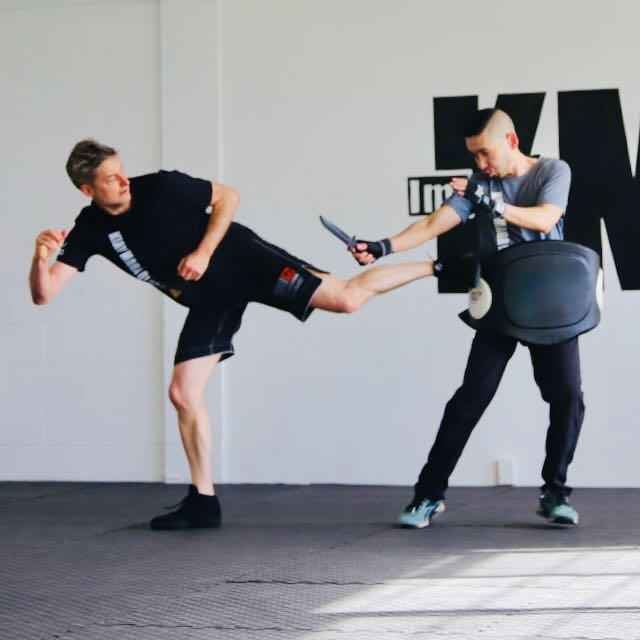
Drilling under pressure at 47 Birkenhead Avenue, North Shore Auckland.
What does "mental toughness" actually mean in this context?
Mental toughness, in the context of Krav Maga training, means staying functional when your body and brain are both telling you to stop. It doesn't mean being fearless. It means continuing to make decisions — to move, breathe, and act — when fear and adrenaline are already in the room.
That's a specific, trainable skill. It's not a personality trait you either have or don't. It's built the same way any other skill is built: through deliberate, progressive practice with appropriate challenge. And it happens to be exactly what the KMG curriculum is structured to develop.
In real self-defence terms, this matters enormously. Most people who freeze in a threat situation don't freeze because they don't know what to do. They freeze because their nervous system has no prior experience of operating under that kind of pressure. The physical technique they've practised in calm conditions simply isn't available when everything speeds up and the adrenaline hits.
Why physical stress in training builds psychological resilience
Every time you finish a difficult drill, you create a small piece of evidence that you can handle more than you thought. That evidence accumulates. After enough sessions, your confidence isn't based on belief — it's based on demonstrated experience.
This is why the physical demands of Krav Maga matter beyond fitness. At KMG North Shore, Instructor Aaron and Instructor Brad deliberately structure sessions so that technique work happens when your body is already working hard. You're asked to execute correctly when tired, slightly out of breath, heart rate elevated. Not to overwhelm you — but to teach your nervous system that you can still function in that state.
There's also something about controlled contact in training that most people don't expect. The first time a training partner grabs your wrist or simulates an attack, your body reacts as if it's real. By the twentieth time, your nervous system has started to recalibrate. Not because the threat has disappeared — but because you've survived it, repeatedly, in a structured environment. That recalibration is the foundation of genuine composure under pressure.
How scenario training at KMG North Shore works differently
The most important thing about scenario-based training is that you don't know exactly what's coming. That uncertainty is intentional, and it's where most of the psychological development happens.
Traditional martial arts training often involves choreographed sequences — you know what attack is coming, and you know which defence follows. There's real value in that for developing technique. But the mental experience is entirely different from dealing with an unpredictable situation under pressure.
In KMG curriculum training at Birkenhead, scenario drills introduce variables: the attack might come from a different angle, the aggressor might respond in a way you didn't anticipate, the timing might change. Your first technique might not work, and you have to adapt immediately. That experience — adapting under pressure, recovering from a failed response, continuing to act rather than freezing — is where mental toughness is actually built.
The progressive structure matters enormously here. Instructor Aaron and Instructor Brad calibrate the challenge level carefully. Early sessions focus on controlled technique in safe conditions. As your competence and composure develop, scenarios become more complex and less predictable. The challenge always sits just ahead of where you are — demanding enough to grow your capacity, never so overwhelming that it reinforces helplessness.
"The teaching curriculum is very structured, organised and logical. Very practical, realistic and highly applicable — a genuine self-defence system."
— Victor, KMG North Shore studentWhat happens to your decision-making when adrenaline hits
When you're under genuine threat, the part of your brain responsible for clear, rational thinking becomes less accessible. Your body shifts resources toward immediate physical response. Your field of vision narrows. Fine motor skills deteriorate. This is normal and useful — but it means that techniques practised only in calm conditions often don't transfer when it actually matters.
The Krav Maga approach at KMG North Shore addresses this directly. Techniques are progressively trained under increasing pressure so that the response becomes more reflexive. You're not relying on a chain of conscious decisions when adrenaline hits — you're drawing on patterns your nervous system has practised enough times that they run without needing to be thought through step by step.
This also applies to situational awareness. The most valuable self-defence skill is reading a situation early enough that you have more options — creating distance, avoiding an escalation before it becomes physical. That capacity for early, calm assessment is trained in every session, not saved for advanced students. From your first class, you're working on how to read an environment and recognise risk before it closes in on you.
How the mental gains show up outside the gym
The psychological shifts from Krav Maga training tend to surface in ordinary life before people notice them in the gym. Students often describe handling a stressful work situation with unexpected calm, recovering from a setback faster than they expected, or finding that they're less reactive in conversations that would previously have escalated their anxiety.
This isn't surprising when you understand what the training is actually doing. The same capacity that allows you to stay composed when a training partner grabs your wrist — noticing the physiological response, managing it, continuing to act — is the same capacity that helps you think clearly in a high-stakes meeting or respond productively to unexpected bad news.
The confidence that develops is also different in character from the kind built through gym workouts or even other martial arts. It's specific, concrete, and based on demonstrated evidence. You don't feel more capable because you've been told you are. You feel more capable because you've proved it to yourself, repeatedly, in conditions that felt genuinely challenging when you started.
For many members at KMG North Shore, this translates into a broader shift in how they relate to difficulty. Challenging situations become problems to work through rather than threats to avoid. That's a meaningful change that extends well beyond any self-defence scenario.
"As a woman of a smaller build I have found that these classes have strengthened me both physically and mentally. Anyone can learn from here — it is a positive, open and welcoming environment."
— Christine, KMG North Shore studentWhat failure in training is actually for
One of the most useful things about Krav Maga training at KMG North Shore is that your first technique sometimes doesn't work — and that's entirely by design. Scenarios are structured so that adaptation is required. Your training partner resists, counters, or responds in a way you didn't anticipate. You have to continue rather than stop.
This is psychologically significant for most adults who join. Many people carry a deeply uncomfortable relationship with failure — the tendency to freeze, apologise, or disengage when something doesn't work as planned. Training in an environment where setbacks are normal, expected, and immediately followed by adaptation slowly dismantles that pattern.
Over time, students develop what coaches call "failure tolerance" — the ability to make a mistake, register it, and continue without losing composure or momentum. In self-defence terms, this is essential. In life terms, it's equally valuable. The person who can handle an error without spiralling is better equipped for almost every professional and personal challenge they'll face.
The community aspect of the gym reinforces this. When you see other capable members — people you respect — working through the same difficulties, failing and adapting and improving, the experience of struggle stops feeling like personal inadequacy and starts feeling like the normal texture of learning something real. That reframe alone is worth quite a lot.
What People Ask About Mental Toughness and Krav Maga
Most people notice the first psychological shifts within the first four to eight weeks — typically a greater sense of composure in situations that previously felt stressful, and a quieter confidence in how they carry themselves day-to-day. The deeper changes, including genuinely different responses under pressure, build over several months of consistent training. Mental conditioning follows the same trajectory as physical skill: gradual, cumulative, and most visible in hindsight.
No. Mental toughness is built through training, not required before it. At KMG North Shore, the training is calibrated to your starting point — beginner sessions introduce pressure gradually, and Instructor Aaron and Instructor Brad are experienced in managing the challenge level so students develop capacity without being overwhelmed. Everyone starts somewhere. The training meets you where you are.
Freezing and hesitation are completely normal responses in early training — they're signs your nervous system is taking the scenarios seriously. Instructor Aaron and Instructor Brad will help you work through those responses rather than around them, using progressive exposure to build familiarity and reduce the panic reaction over time. The goal isn't to never feel fear. It's to build the ability to act anyway — and that takes practice, not willpower.
Yes, and this is one of the things students most consistently report. The composure built through training regularly surfaces in non-physical situations — handling workplace pressure, recovering from setbacks more quickly, and feeling less reactive in conversations that previously triggered anxiety. The nervous system doesn't distinguish between physical and professional stress as cleanly as we might assume. Composure is composure, regardless of the context it was built in.
Many people who train at KMG North Shore cite managing stress and anxiety as one of the reasons they started and one of the main reasons they stay. The combination of physical exertion, skill development, and progressive exposure to manageable pressure tends to reduce general anxiety levels over time. That said, Krav Maga is physical training, not therapy. Anyone dealing with significant mental health challenges should speak with a professional, and training alongside that support rather than as a replacement for it.
Krav Maga Auckland — KMG North Shore — trains at 47 Birkenhead Avenue, Birkenhead, Auckland 0626. Classes run Saturday mornings (8:00–9:00am), Monday evenings (6:30–7:30pm), and Wednesday evenings (6:30–7:30pm). All beginner sessions are mixed-level and open to people with no prior martial arts experience. Free parking is available at Highbury Mall directly opposite.
Find Out What You're Capable Of
Book your first session at Birkenhead — we'll guide you from there. No experience needed.
Book Your First Session47 Birkenhead Avenue · Sat 8am · Mon & Wed 6:30pm