What Do You Actually Learn in Krav Maga? — Krav Maga Auckland
Krav Maga Auckland teaches practical self-defence skills drawn from real-world situations — striking, defending against grabs and weapons, ground survival, and how to read a threat before it escalates. Training is built on the KMG curriculum developed by Eyal Yanilov, structured so you progress from core techniques through to advanced scenarios. You don't need any prior experience — most students are surprised at how quickly it starts to feel natural.
Most people who search "what do you learn in Krav Maga" are really asking a different question: is this actually going to be useful to me? It's a fair thing to wonder. There's a lot of self-defence content out there that looks impressive on video but wouldn't work under pressure.
The short answer is that Krav Maga is different — not because of what's taught, but because of how and why. Everything in the curriculum comes back to one principle: what actually works when the adrenaline is spiking and you don't have time to think.
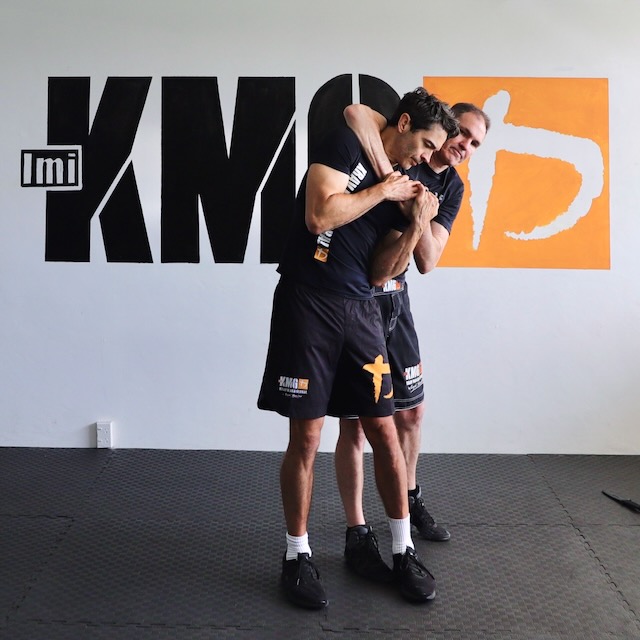
Instructor Aaron and Instructor Brad — headlock defence drill, Krav Maga Auckland, Birkenhead.
What Is Krav Maga, and Where Does It Come From?
Krav Maga is a self-defence system developed in Israel and taught to the Israeli Defence Forces from the 1950s. It was created by Imi Lichtenfeld, who designed it around one idea: give ordinary people the ability to protect themselves quickly and effectively, regardless of their size, age, or athletic background.
The version taught at Krav Maga Auckland is the KMG (Krav Maga Global) system — the direct continuation of Imi's work, led today by his protégé Eyal Yanilov. KMG operates across more than 60 countries with over 1,500 active instructors, and is the only lineage that traces directly back to Imi himself. The curriculum is structured, tested, and continuously updated — which is why it's trusted not just by civilians, but by military and law enforcement units worldwide.
Key takeaway: Krav Maga has real roots, a real lineage, and a curriculum designed specifically for civilians — not soldiers, and not sport competitors.
What Skills Do You Build in Krav Maga Training?
The KMG curriculum covers five interconnected skill domains, all trained in parallel from your first class. Nothing is siloed — you don't spend a year on stances before you learn anything useful. From early on, you're working across all of them at whatever level matches your experience.
Striking
Punches, palms, elbows, knees, kicks — how to generate real power quickly and from awkward positions. Not sport punching — real striking for real situations.
Defending Attacks
Blocking, deflecting, and moving your body off the line of an incoming strike. Combined with an immediate counter — defence without a counter isn't self-defence, it's just absorbing punishment.
Grappling and Releases
Getting free when someone grabs you — by the wrist, shirt, throat, or in a headlock. How to stop someone taking you to the ground, and what to do if they do.
Ground Survival
What to do if you end up on the ground — which is more common in real confrontations than people realise. How to get up, how to defend yourself, how to get to safety.
Weapon Threats
Defences against knives, sticks, and firearms — starting from threats and escalating to live attacks. These aren't sport techniques. They're built around the reality of how weapon assaults actually happen.
Situational Awareness
Recognising a threat before it becomes an attack — reading body language, positioning, and the escalation signs most people miss until it's too late.
Key takeaway: You build a complete toolkit — not just one skill. By the time you're a few months in, you're working across striking, grappling, ground defence, and threat recognition in the same session.
Is Krav Maga Different from Other Martial Arts?
The biggest difference is what Krav Maga is optimised for. Most martial arts were developed as fighting systems or sporting competitions — which means they have rules, weight classes, referees, and assumptions about what your opponent will do. Krav Maga has none of those.
It's built around real scenarios: surprise attacks, multiple aggressors, weapons, confined spaces, low light. The techniques are chosen because they work under adrenaline, not because they're beautiful to watch. And the training is designed to stress-test what you've learned — not just rehearse it in a controlled drill.
That doesn't mean other martial arts don't have value. Many Krav Maga students also train in BJJ, boxing, or other disciplines. But if what you're after is the most direct path to practical self-defence ability, Krav Maga is built specifically for that.
Key takeaway: Krav Maga isn't a sport and it isn't a traditional martial art. It's a system built around the specific problem of protecting yourself in real life.
How Does the Curriculum Actually Work?
The KMG civilian curriculum runs through Practitioner (P1–P5), Graduate (G1–G5), Expert (E1–E5), and Master levels. Each level builds on the last, introducing new techniques while deepening your ability to apply everything you've already learned under pressure. The Master tier is open-ended — Eyal Yanilov currently holds M3, and the level continues to evolve as he develops the system.
Beginners start at Practitioner 1. By P5 you're handling weapon threats, multiple aggressors, and ground scenarios. The Graduate levels deepen all of that — faster reaction times, more complex situations, and the tactical thinking that makes the techniques stick when the stress is real. Beyond the civilian track, KMG also runs specialist instructor courses for law enforcement, military, VIP and close protection, and kids — which tells you something about the depth and credibility of what's behind the civilian curriculum you train.
Classes at Krav Maga Auckland on the North Shore follow this curriculum, which means your training builds systematically — not randomly. Every class connects to what came before and prepares you for what comes next. If you want to see how progression works in practice for Auckland students, how you progress in Krav Maga training covers that in detail.
Key takeaway: There's a clear map from where you are now to where you want to get to. And the system behind that map is trusted by military and law enforcement worldwide — not just civilians.
What Does a Typical Krav Maga Class Look Like?
A typical class at Krav Maga Auckland runs 60–75 minutes and covers warm-up, technique work, and pressure testing — usually in that order. The warm-up is active and movement-based. Technique work introduces or sharpens a specific skill. The pressure portion is where it all gets tested — against a non-compliant partner, in a drill that doesn't let you switch off.
Classes are mixed-level by default, which works because the curriculum is structured. A student three months in and a student three years in can train together — they're working on different details within the same framework. Instructor Aaron and Instructor Brad both run classes, and both bring the same commitment: that every student, regardless of where they're starting from, leaves knowing more than when they arrived.
"The teaching curriculum is also very structured, organized and logical. Very practical, realistic and highly applicable form of martial arts and self-defence system."
— VictorKey takeaway: Classes are challenging and purposeful — not chaotic. You'll work hard, but you'll always know why.
Do You Need to Be Fit or Strong to Start?
No — and this comes up a lot. The techniques in Krav Maga are designed to work regardless of size, strength, or prior fitness. That's not a marketing claim — it's a design principle. A self-defence system that only works if you're already athletic isn't much use to most people.
What you will find is that fitness follows naturally. Most students notice genuine improvements in strength, endurance, and coordination within the first few weeks — not because there's a fitness programme layered on top, but because the training itself demands it. It's a side effect of doing something that's physically real.
The Krav Maga Essentials course is the recommended starting point for most new students. It's a structured introduction that covers the core techniques and gives you a proper foundation before you step into the regular class schedule.
What Do You Walk Away With After Six Months of Training?
Six months of consistent training gives you a genuinely different relationship with your own capability. Technically, you'll have solid striking across hands and legs, reliable defences against the most common attacks, a working understanding of how to manage distance and positioning, and the foundation of ground awareness. You'll have tested all of that under real pressure, not just in drills.
But the thing most students describe most is the shift in how they carry themselves. Not aggression — the opposite. When you know you have real options if something happens, you stop worrying about it the way you used to. That's what the training builds toward: not a false sense of invincibility, but a quiet, grounded confidence that comes from actually being prepared.
"Since joining with no prior experience I've learnt many tactical skills – all of which have improved my assertiveness and confidence."
— SuvenCommon Questions
What People Ask About Krav Maga
Yes — most people who train at Krav Maga Auckland started with no martial arts or self-defence experience at all. The KMG curriculum is built to progress systematically from the basics, and the Essentials course is specifically designed to bring new students up to speed before they join the regular class schedule. You don't need a fitness base, fighting experience, or any particular physical ability to get started. What you need is the decision to show up.
Boxing, BJJ, and MMA are optimised for competition — they have rules, weight classes, and agreed conditions. Krav Maga is designed specifically for the situations those sports exclude: surprise attacks, multiple aggressors, weapons, and environments where there's no referee and no equal match. Many Krav Maga students also train in combat sports, and the crossover is genuinely valuable. But they're solving different problems. At Krav Maga Auckland, the goal is practical self-defence ability — not sport performance.
Most students at Krav Maga Auckland notice a meaningful shift in awareness and basic technique within the first 6–8 weeks of consistent training. By three to six months, you'll have a solid foundation across striking, defence, and ground awareness. The KMG curriculum runs through Practitioner, Graduate, Expert, and Master levels — so there's always more depth to develop. But "capable of protecting yourself" doesn't take years. It takes showing up consistently and working through the material. Training once or twice a week is enough to make real progress.
Yes — weapon defence is a core part of the KMG curriculum, introduced progressively as students develop their foundation skills. Early training covers defences against knife threats and stick attacks. As you progress through the Practitioner and Graduate levels, you'll work on disarms, live-attack defences, and scenarios that involve weapons combined with other threats. At Krav Maga Auckland, weapon defences are always taught in context — with attention to the legal, tactical, and physical realities of each situation.
Yes — and not in a "we've adapted it" sense. The core KMG system is designed to work regardless of size or strength, which means the techniques translate directly to realistic situations women are more likely to face: close-range threats, grabs, being followed, and confrontations where a size disadvantage is a factor. Krav Maga Auckland has a dedicated Women's Self-Defence programme for those who prefer a women-only training environment, alongside the mixed classes. Many women train in both.
Krav Maga Auckland · North Shore
Explore Local Krav Maga Training
See class details, location info, and the best next step for beginners on Auckland's North Shore.
View North Shore Training47 Birkenhead Avenue, Birkenhead, Auckland · 027 214 9461