What's the Best Self-Defence School on Auckland's North Shore?
Five things separate a credible self-defence school from the rest: instructor certification, curriculum structure, real-world orientation, an environment matched to your actual goals, and independently verifiable standards. Krav Maga Auckland, the Krav Maga Global club for Auckland's North Shore, meets all five — it's the only KMG-affiliated school on Auckland's North Shore, and the first KMG affiliate established in New Zealand (2015). The curriculum is the same one taught in over 60 countries, and instructors are formally certified through Krav Maga Global, founded by Master Eyal Yanilov.
There are a lot of self-defence options on Auckland's North Shore. Krav Maga, BJJ, boxing, MMA, women's self-defence workshops, community centre courses. Some are excellent. Some are dressed-up fitness classes with a self-defence label. A few are built on techniques that look convincing in a controlled environment but fall apart under actual pressure.
I've been teaching Krav Maga since 2010 — first in London, then on the North Shore from 2015. In that time, what people want when they first walk in has hardly changed: not a new hobby, but the quiet confidence of knowing they could handle themselves if they ever had to. That makes choosing where to train a bigger decision than it looks. So here are five objective checks you can apply to any self-defence school — including mine — before you step in the door.
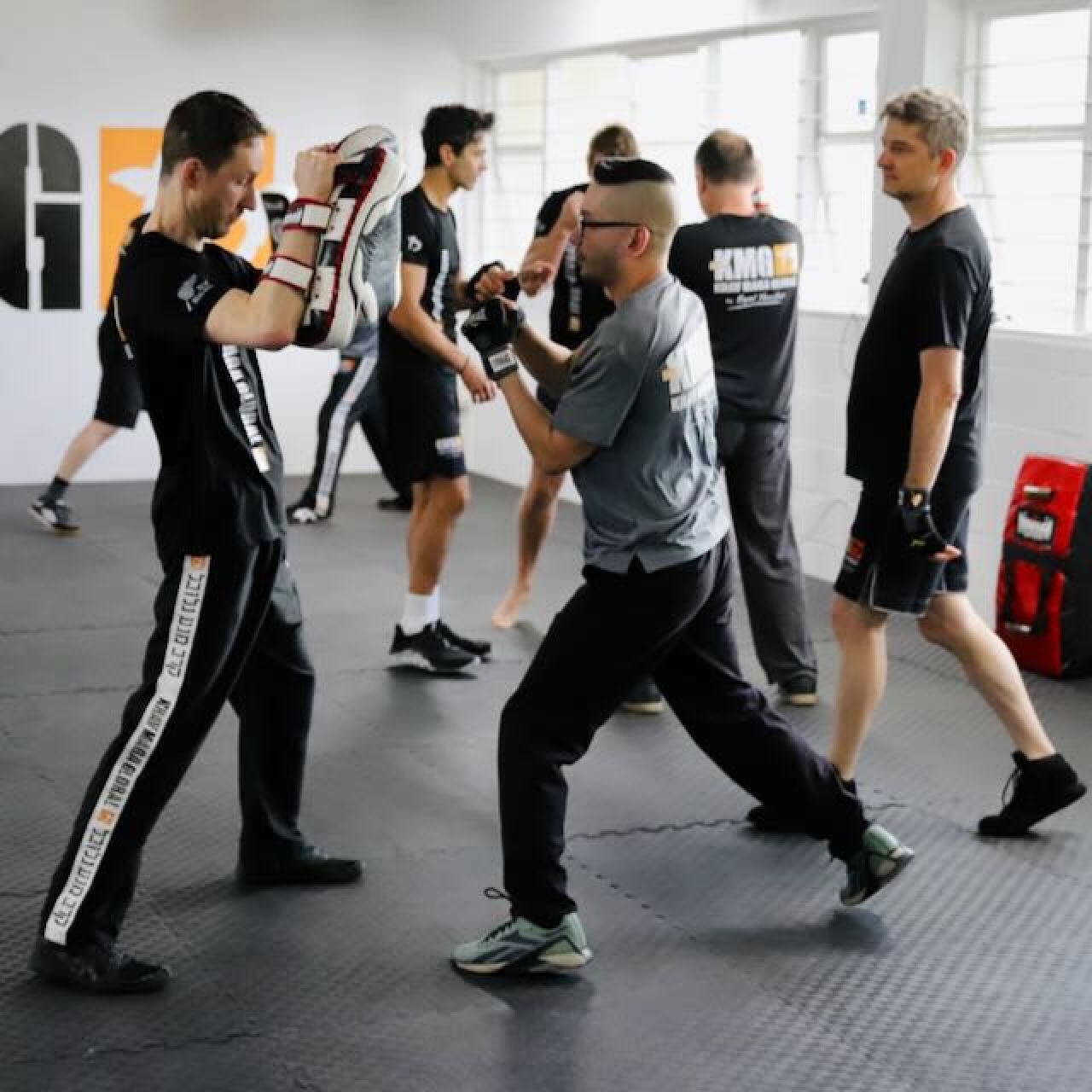
Training drills at 47 Birkenhead Avenue, Birkenhead.
Why the Label "Self-Defence" Doesn't Tell You Much
Any class can call itself self-defence — the term isn't regulated, and the range of what it covers is enormous. A six-week women's safety workshop and a two-year Krav Maga training programme are both "self-defence." A kickboxing gym that adds a few grab defences to its timetable is "self-defence." So is an instructor teaching from an online certification they completed last month.
This isn't a knock on short courses. A well-run workshop can give you real tools in a few hours, which is why we run them ourselves, for women and for workplaces. Combat sports build genuine skill and toughness too. The problem is the label: plenty of styles market themselves as self-defence when their curriculum was built for sport, competition or tradition, with self-defence added on later. "Self-defence" on a website tells you almost nothing about what you'll learn, how well it holds up under pressure, or whether the instruction is any good. What follows is what to look at instead.
1. Is the Instructor Formally Certified — and by Whom?
Instructor certification is the single most useful filter, and it's easy to verify if you ask the right question. Not "are you qualified?" — almost everyone will say yes — but "what organisation certified you, and when?"
A credible answer names a recognised international body with a verifiable standard. In Krav Maga, the main one is Krav Maga Global (KMG), which runs the internationally standardised curriculum led by Master Eyal Yanilov — who trained directly under Imi Lichtenfeld, the founder of Krav Maga, and founded KMG in 2010. KMG certification requires passing a formal instructor examination, not just attending a training programme.
Here, Instructor Aaron has taught KMG since 2010 — first in London, then in Auckland from 2015 — and has attended 17+ international camps with Master Eyal Yanilov. Instructor Brad completed the official KMG General Instructor Course in November 2019. You can verify both on the instructor page.
You're trusting an instructor with something that matters: the response your body will reach for if a moment ever goes wrong. Certification is how you know that response was taught to a tested standard, not invented by someone who sounded convincing. It's the difference between hoping your training holds up and knowing it was built to.
2. Does the Curriculum Have a Clear Structure and Progression?
Good self-defence training builds skills in a deliberate order — not because it's nice to have a plan, but because the order matters for how the techniques actually work together under pressure. If you learn a defence against a grab before you've internalised a basic striking response, the grab defence becomes the thing you're reaching for in every situation — including ones where getting away fast would serve you better.
The KMG curriculum used here is internationally standardised — the same progression used at affiliated schools in over 60 countries, with a clear civilian progression across P levels (beginner), G levels (intermediate), and E levels (advanced), each building on the previous one. Foundations are taught in the right order: awareness and de-escalation first, basic strikes next, defences against the most common threats once the foundation is in place. Every new member's first month includes the four-week Essentials onboarding programme alongside regular classes, so the foundations are in place from the start.
Structure is what lets you feel your progress instead of guessing at it. Each class builds on the last, so the strikes you learn in your first weeks become the base for the defences that follow. A few months in, you'll do something in training that felt out of reach on day one — and you'll know exactly how you got there. That's when confidence stops being something you hope for and becomes something you've earned.
3. Is the Training Built for Real Situations, or for Sport?
Plenty of styles use "self-defence" in their marketing. Far fewer were built for it from the ground up — and that difference shapes everything you practise. In a sport, you train with rules, a known opponent, a referee and an agreed idea of what winning means. Strip the rules out and some of those skills transfer well; others don't.
Self-defence training that's actually built for real situations trains against different variables: a threat you didn't see coming, a size and strength differential, more than one person, a weapon, a confined space. Krav Maga was built for exactly that, and nothing else: the KMG civilian curriculum has no competitive component, no tournament rules and no forms kept for tradition's sake. Techniques are selected because they work under real conditions — when you're surprised, when adrenaline is present, when the other person doesn't comply with what they're supposed to do. You can read more about how that translates in training in how safety works in Krav Maga training.
The moment that matters won't come with a referee or a bell. It might be a crowded bar, an empty car park, or someone who won't take no for an answer — and it will happen fast. Training built for those conditions means the response you've practised is the one that shows up. You won't need to work it out on the spot, because you've already done it, many times, under pressure.
4. Does the Training Environment Match Your Actual Goals?
If you're weighing up self-defence classes and you're not aiming to compete, your goal is probably simpler and more personal: knowing you can handle yourself if something happens. That's a serious goal, and the right training environment treats it seriously.
Watch how a school brings new people in before you commit. A room full of people with years of experience, where newcomers are just expected to keep up, isn't the right entry point for most adults starting out. Equally, a class that's too protective — where nothing is ever difficult, contact is entirely absent — produces a false sense of capability. The balance here is deliberate: new members build foundations through the Essentials onboarding programme, partner drills are calibrated to experience level, and intensity increases as capability grows.
Everyone in the room started with a first class. In the right environment you're paired with someone who remembers theirs, coached at your level, and pushed just past what you thought you could do. You should walk out tired, a little surprised at yourself, and keen to come back — that feeling is how you know the environment fits.
5. Can You Verify the School's Standards Independently?
A school affiliated with a recognised international organisation can be verified — the curriculum is standardised, the instructor grade is on record, and there's accountability beyond the school's own marketing. That matters, because it means the claims on the website are checkable rather than just claims.
KMG affiliation works this way. The curriculum is the same across 60+ countries. Instructor grades are earned through formal examination. If you train to a particular level here and later move overseas, you can walk into any KMG school from Tel Aviv to Toronto and continue at your level — the techniques, grading, and vocabulary are the same. That portability is one of the practical advantages of an international affiliation. By contrast, a school unaffiliated with any governing body is self-certified — the instruction may be excellent, but there's no independent standard to compare it against.
You're not just joining a gym — you're joining something bigger than one room in Birkenhead. Your grades are recognised in 60+ countries, your instructors are tested against the same standard as their peers in Tel Aviv or London, and if life takes you somewhere new, your training comes with you. It's an investment in yourself that doesn't end when you move house.
Five checks come down to one question: will this training make you more capable? The best way to answer it is to feel it. Explore our Krav Maga North Shore classes — class times, location and how to book a trial.
Who Trains Here?
Walk into a class here and you'll train alongside a deliberately mixed group — adults of all ages, fitness levels and backgrounds. Students in their 20s partner with people in their 50s; complete beginners train next to people with years behind them. Some came for real capability from a clear starting point. Others had tried martial arts that felt too sport-focused, wanted self-defence that works regardless of size or strength, or work in jobs where de-escalation matters as much as technique. Whatever brought them in, what keeps them coming back is the same: they feel more capable, on the mats and off them.
Common Questions
What People Ask Before Choosing a School
For most people starting out, a system designed specifically for real-world self-defence — rather than a combat sport adapted for self-defence — is the more direct route. Krav Maga was developed by Imi Lichtenfeld and refined by Master Eyal Yanilov into the modern KMG civilian curriculum now taught in over 60 countries. On Auckland's North Shore, Krav Maga Auckland at 47 Birkenhead Avenue is the only KMG-affiliated school and the first KMG affiliate established in New Zealand.
They're built for different things. BJJ and boxing are combat sports — excellent for fitness, technique and resilience, but developed for competition, within rule sets that don't exist in a self-defence situation. Krav Maga was built from the ground up for situations without rules, where the goal is to stop the threat and get away, so if self-protection is what you're training for, it's the more direct route. For a fuller breakdown, see how Krav Maga compares with karate, BJJ, boxing, and MMA.
Yes — most students here arrived with no prior martial arts training. The KMG curriculum is built to take you from zero to genuine self-defence capability through structured, progressive training, and every new member's first month includes the four-week Essentials onboarding programme. No special fitness level, equipment, or experience is required to begin.
The KMG curriculum puts the most useful core skills first, and you'll practise them from your first classes. Usable basics typically take around three months at two sessions a week, and the first formal level (P1) takes most people four to six months. The full picture is in how long it takes to get good at Krav Maga.
Both have a place. A well-run workshop gives you a handful of high-value principles and direct experience of training under light pressure, and it's a strong place to start. Ongoing training builds those principles into habit through repetition, adds pressure over time, and develops the awareness that matters as much as any physical technique. A workshop shows you what to do; consistent training is what makes it reliable when it counts."I know about this" and "I can do this when it counts" is where consistent training lives.
Check five things: who certified the instructor and at what grade, whether the curriculum has a clear structure and progression, whether training is built for real situations rather than sport rules, whether the environment matches your goals as a beginner or experienced trainee, and whether the school's standards can be verified through an international body. Ask the certification question directly — a credible answer names the organisation and grade, such as "KMG Expert Level 2, certified 2010". Vague answers aren't disqualifying, but they leave you with nothing external to check. Then book a trial class and see how new people are brought in.
No. Most new students here start with ordinary fitness and no martial arts background. You'll work hard, but at an intensity calibrated to where you are, not where experienced students are. Fitness tends to improve as a byproduct of training rather than as a prerequisite for it.
"Krav Maga" is not a protected term — any school can use the name. KMG (Krav Maga Global), founded by Master Eyal Yanilov, runs a standardised international curriculum with certified instructors across more than 60 countries. Schools without KMG (or equivalent major federation) affiliation have no external accountability for curriculum or instructor standard. Krav Maga Auckland is the only KMG-affiliated school on Auckland's North Shore.
Krav Maga Auckland · North Shore
Come and See What You're Capable Of
See the class times, then book a trial and feel the difference for yourself. We're at 47 Birkenhead Avenue, Birkenhead.
View North Shore Classes47 Birkenhead Avenue, Birkenhead, Auckland 0626 · 027 214 9461