How Long Does It Take to Get Good at Krav Maga?
There isn't a fixed point when someone becomes "good" at Krav Maga. At our North Shore club, adults training consistently twice a week will usually start developing usable fundamentals within their first few months. Over the following months we progressively add resistance, surprise and pressure. Becoming reliably capable across a wider range of situations takes sustained training measured in years rather than weeks.
"Good at Krav Maga" isn't a single finish line. You build capability in layers: awareness first, then usable technique, then technique that holds up when your heart rate spikes.
This guide lays out a realistic progression, what you can expect to develop at each stage, and what speeds your progress up or slows it down.
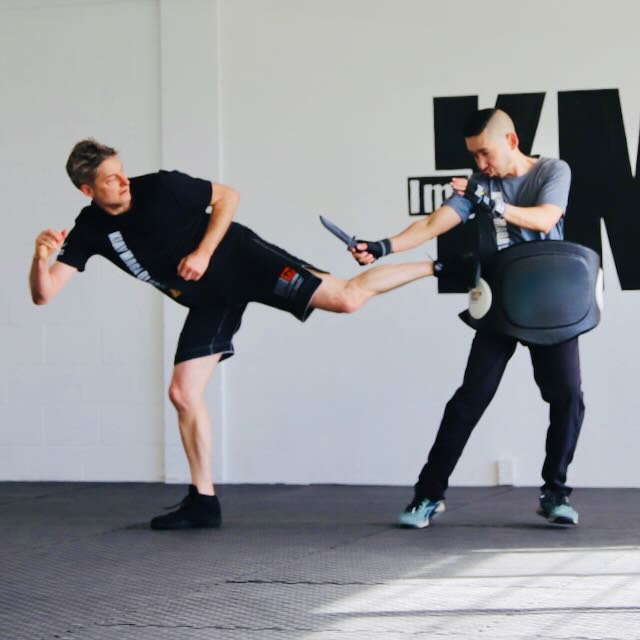
Beginners class: stance and movement come first at Krav Maga Auckland, Birkenhead.
Start building real capability
You don't need to be good before you start. Train with us in Birkenhead and build your skills progressively.
What does "good at Krav Maga" actually mean?
Being good at Krav Maga means you can respond effectively to a threat, not that you've memorised a large number of techniques. That's a different goal from simply measuring progress by how much material you've learned, and it changes how you should think about improvement.
Capability builds in three layers. The first is awareness: reading a situation early, keeping distance and getting out before anything physical happens. The second is functional technique: simple, direct responses to the most common attacks. The third is performance under stress: making good decisions and moving well when you're surprised, tired or adrenalised.
Each layer takes longer than the one before it. Awareness and basic movement can improve within weeks. Making reliable decisions and applying techniques under increasing pressure develops through consistent training over months and years.
What is a realistic Krav Maga timeline?
For an adult training consistently around twice a week, the stages below are a useful guide rather than a guarantee. People progress at different rates, but regular training gives skills time to build on one another.
Settling in
You learn how classes run, a stable stance, how to move and how to hit simple targets. Drills still take conscious thought, but the unfamiliar starts becoming familiar.
Foundations become usable
Straight strikes, releases from common grabs and defences against pushes become more familiar and increasingly reliable in controlled drills. You also begin to recognise the same principles across different attacks.
Adding resistance and pressure
As your foundations improve, drills can add more resistance, surprise, fatigue and decision-making. Students often begin hesitating less and recovering more quickly when something doesn't go exactly as expected. Around this stage, many are also ready for their first KMG grading.
Responses become more natural
Core techniques require less conscious thought and can be tested in increasingly varied situations. Training expands to different attacks and angles, more tactical decision-making and, when appropriate, introductory work involving more complex threats.
Broader capability under pressure
With sustained training, you become better at adapting to what is actually happening rather than simply reproducing a set drill. Decisions about when to act, when to escape and how to respond become increasingly integrated with the physical skills.
The first four weeks follow a clear pattern, and it helps to know what your first Krav Maga class looks like before you start.
Formal milestones run alongside this progression. At Krav Maga Auckland, the first KMG grading, Practitioner Level 1, commonly comes after about 40 classes, which for someone training twice a week is typically around four to six months. You can see how the P, G, E and Master levels fit together in the KMG grading and progression system.
What can you defend against at each stage?
What you can handle grows as your skills develop, but no training timeline can guarantee how someone will perform in a real confrontation. The aim is to progressively increase the range of problems you can recognise, avoid and respond to.
In the first few months
Your strongest tools are awareness and distance: noticing trouble early, positioning yourself near an exit and leaving before a situation escalates. On top of that, you'll begin developing direct responses to common physical attacks such as wrist and clothing grabs, pushes and straight punches.
From six months onward
As the foundations become more reliable, training can move into less predictable situations: attacks from different angles, more resistance, more complex decision-making, more than one person and, progressively, threats involving weapons.
Armed threats are among the hardest problems in self-defence, and intermediate training does not make anyone an expert at dealing with them. The objective is to build better awareness, decision-making and structured responses rather than assume there is a guaranteed technique. Our approach to knife defence training starts with recognising the danger and escaping where possible, before any physical technique.
With longer-term training
More experienced students can work with increasingly difficult scenarios: surprise attacks, confined spaces, low light and situations where de-escalation, movement and physical defence have to work together. The objective is not simply to make the scenarios harder, but to make good decisions and effective responses more reliable when conditions are less comfortable.
What speeds up or slows down your progress?
Consistent training is one of the biggest influences on progress, along with practising skills under progressively more realistic resistance and pressure. Your starting fitness or martial arts background can help, but neither replaces regular practice.
Frequency. For many adults, two classes a week provides a useful balance between repetition and recovery. Once a week can still build skill, but progress will generally be slower because there is more time between repetitions.
Consistency. Regular attendance matters more than occasional bursts of training because repetition helps movement become familiar and increasingly automatic. The detail is in our guide to why consistent Krav Maga training matters.
Pressure. A technique that works slowly with a cooperative partner is not yet the same as one you can apply when surprised, tired or under resistance. Stress-based training helps close that gap by progressively testing skills in more demanding conditions.
Background and fitness. Experience in sport or another martial art can give you a head start with movement, coordination and physical confidence, although some habits may need adapting. Fitness helps too, but it also develops through training. If you want to know what the sessions demand physically, read how intense beginner training is.
What happens if you miss classes?
Missing a few weeks may slow your progress, but it doesn't send you back to the beginning. Knowledge tends to remain even when timing, fitness and automatic reactions feel less sharp.
When you return, the first few sessions are usually about restoring familiarity and timing rather than relearning everything from scratch. Between classes, a few minutes of stance, movement and basic strikes at home can help maintain familiarity. Tell your instructor you've been away so they can help you return at an appropriate pace. There are more practical strategies for training around a busy schedule.
How does Krav Maga Auckland structure your progress?
Krav Maga Auckland teaches the graded Krav Maga Global (KMG) curriculum, building skills progressively from core foundations toward more complex problems. The objective is not to rush beginners into high-pressure training, but to develop the skills and fitness first and increase the challenge as the student becomes ready for it.
Classes run on Monday and Wednesday evenings and Saturday mornings at 47 Birkenhead Avenue, Birkenhead, which makes two sessions a week realistic for many schedules. Instructor Aaron (KMG Expert Level 2, teaching since 2010) and Instructor Brad (KMG Graduate Level 2) give direct feedback in class so students know what to work on next.
If you want a structured start, the four-week Krav Maga Essentials course runs alongside your first month of classes and walks you through the core foundations with weekly videos and articles.
"The teaching curriculum is very structured, organised and logical. Very practical, realistic and highly applicable — a genuine self-defence system."
— VictorFor class times and how to find us, see Krav Maga classes on the North Shore.
What People Ask About Krav Maga Progress
A few weeks can give you useful foundations: stance, movement, awareness of distance, simple strikes and introductory releases from basic grabs. That is a worthwhile start, but applying those skills reliably under pressure requires repetition and progressively more demanding training over time. Short courses work best as a starting point rather than a finish line.
For many adults, two classes a week is a sustainable frequency that provides regular repetition while leaving time to recover. At Krav Maga Auckland that could be a Monday or Wednesday evening class plus the Saturday morning session. One class a week can still build skill, but progress will generally be slower because there is more time between repetitions.
Krav Maga is designed to prioritise practical self-defence from the beginning. It does not use forms, competition rules or points scoring, so training time can focus on striking, avoidance, releases, defensive tactics and responses to realistic attacks. That doesn't make long-term skill instant — becoming reliably capable still requires consistent training.
Age can affect factors such as speed, recovery and physical conditioning, but those are only part of self-defence capability. Awareness, timing, decision-making, positioning and consistent practice matter as well. At Krav Maga Auckland, training intensity is developed progressively rather than assuming everyone begins with the same physical capacity.
There is no fixed timetable because people develop at different rates and different skills become automatic at different stages. With consistent training, core movements should require progressively less conscious thought. Stress-based drills then test whether those movements still work when you are surprised, tired or under resistance.
Students training consistently are commonly ready for their first KMG grading, Practitioner Level 1 (P1), after about four to six months, or roughly 40 classes. Gradings are held a few times a year, and your instructor will tell you when you are ready. Grading is optional — the main objective of training is capability, not simply collecting levels.
Krav Maga Auckland · North Shore
See What You Can Build
Start at a comfortable pace. We'll help you develop the skills, fitness and confidence to perform under increasing pressure.
Book Your First SessionNo experience needed. We'll guide you from there.