Knife Defence Training at Krav Maga Auckland
Knife defence is part of the beginner KMG curriculum at Krav Maga Auckland. You start with rubber training knives and controlled drills, then build towards less predictable scenarios as your skills develop. Training prioritises awareness, distance and escape. It can improve your options, but cannot make a knife attack safe or guarantee an outcome.
If you're considering training, the useful questions are what you'll practise, how the difficulty builds, and what you can realistically expect from it. Here's how we teach this part of the curriculum.
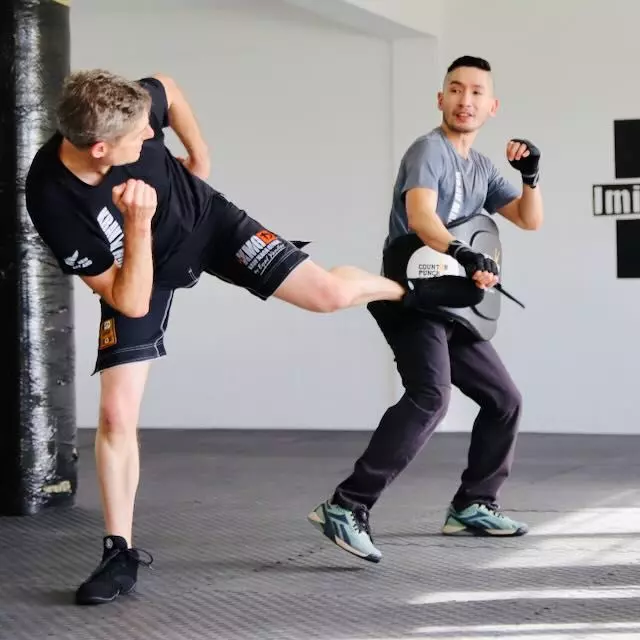
Controlled knife-defence practice with a rubber training knife.
Want to experience how we train? Beginners are welcome at all three Core sessions.
Why is knife defence included from beginner level?
Knife defence appears in Practitioner 1, the first formal level of the Krav Maga Global curriculum. It introduces awareness of weapon threats alongside the movement, positioning and decision-making developed throughout your training.
This doesn't mean beginners are expected to handle every kind of knife attack. You learn manageable pieces first, with clear instruction and a partner working at an appropriate pace. Those foundations connect to more demanding training later.
Our student progression page explains how the wider curriculum develops over time.
What does knife-defence training actually look like?
Early drills are deliberately slow and structured. An instructor demonstrates the exercise, explains its purpose, and helps you practise it with a partner. Repetition gives you time to understand the movement and correct mistakes.
As your skills develop, drills can involve closer distances, repeated attacks, changing angles or a weapon that isn't visible at the start. The exercise becomes less predictable, while instructors still control its purpose and intensity.
A demonstration may isolate one movement so you can see it clearly. A scenario tests whether you can recognise the problem and make decisions as it changes. Both have a place in learning; looking polished in a demonstration is different from responding effectively under pressure.
How do we manage safety and intensity?
Knife-defence drills use rubber training knives, with difficulty introduced progressively. Partner cooperation, clear instructions and instructor supervision help manage the contact and pace of each exercise.
Physical training still carries a risk of injury. Tell your instructor about injuries, limitations or an exercise that feels beyond your current ability, so the drill can be adjusted. The aim is to build skills and confidence at a pace you can manage.
Instructor Aaron and Instructor Brad hold formal KMG instructor certification. Read their instructor profiles or see our approach to progressive training.
How do drills develop into scenarios?
Scenario work adds decisions to the physical skills you've practised. The difficulty builds in three broad steps:
- Controlled drills: learn the movement with a known exercise and cooperative partner.
- Changing conditions: practise with variations in timing, distance or resistance appropriate to your level.
- Scenarios: combine awareness, communication, movement and physical responses in a less predictable exercise.
A scenario may begin with a conversation, a boundary being tested, a grab or a shove, and the weapon may only appear as the situation develops. That forces the shift you need to practise: from general awareness to an immediate threat, and from uncertainty to a decision — step back or close in, control or create distance, act or disengage.
Not every scenario involves a knife. Others cover unarmed assaults, multiple attackers, environmental constraints and situations that begin as verbal escalation. The principle is the same: train for situations as they develop, not only as they appear in a clean drill.
Is knife defence realistic?
It depends what you mean by realistic. If it means guaranteed success, a clean outcome and no risk, no training can offer that. A knife attack is fast and dangerous, even highly trained people can be injured, and no drill reproduces every aspect of a real incident.
If it means improving your ability to recognise danger earlier, decide faster under pressure and create an opportunity to get away, that is what the training is built for. Our priorities are to recognise danger early, avoid engagement where possible, create distance and get to safety. Physical responses are trained for situations where those options are limited or have failed — for example when the distance is too short, you're cornered, or someone with you can't move quickly.
Realism also includes the law. In New Zealand, any force used in self-defence must be reasonable in the circumstances, and training reflects that: the aim is to create a chance to get away and to stop when you can. KMG New Zealand explains how reasonable force is defined.
Why does the training differ from combat sports?
Self-defence training includes problems that a sporting contest usually excludes: weapons, uncertain starting conditions, other people and opportunities to disengage. Those differences shape the drills and the decisions we practise.
Boxing, BJJ, karate and other systems can develop useful attributes such as timing, balance, fitness and comfort with partner work. Prior experience is welcome. Here, you apply those attributes to the KMG curriculum's focus on recognising threats and getting to safety.
Where do common objects fit?
Training also considers the environment around you. An obstacle or an object such as a bag or chair may help create separation or obstruct an attack. What is available, whether you can reach it, and whether using it helps you leave are all part of the decision.
Our common-object self-defence article covers that topic in more detail. The object is only one possible option; the aim remains to reduce danger and get away.
How do I start?
Join a regular Core class at 47 Birkenhead Avenue, Birkenhead. Knife defence is integrated into the wider KMG curriculum alongside striking, releases, ground defence and awareness. What you cover varies by session.
Core sessions run Saturday 8:00–9:00am, Monday 6:30–7:30pm and Wednesday 6:30–7:30pm. All three are open to beginners. Visit our North Shore classes page for booking and current class details.
Questions about knife-defence training
Do beginners learn knife defence?
Yes. Knife defence is included in the Practitioner 1 curriculum, the first formal level of the KMG system. Beginners work with rubber training knives in controlled drills, with pace and complexity matched to their experience.
Will I face fast, unpredictable attacks in my first class?
Beginners start with clear, controlled drills and learn the movement before speed or uncertainty is added. More demanding scenarios are introduced progressively as skills and confidence develop.
Can training guarantee that I will stop a knife attack?
No. A knife attack can cause serious injury even to someone with training. The aim is to improve awareness, decisions and response options, prioritising avoidance, distance and escape wherever possible.
Why not just run away?
If you can get away safely, that is always the best option, and recognising when it's possible is part of the training. The harder situations are those where escape isn't immediately available: the distance is too short, you're cornered, or someone with you can't move quickly.
Do you teach knife disarms?
Yes, but within a wider context of awareness, control and escape rather than as standalone solutions. A disarm in a controlled drill is a useful learning tool; it is not a guaranteed outcome in a real incident.
Do I need martial arts experience or equipment?
No prior experience is needed. Rubber training knives are provided for these drills. Come in comfortable training clothes; instructors will explain any equipment you need as you progress.
When and where can I train?
Core classes run at 47 Birkenhead Avenue, Birkenhead: Saturday 8:00–9:00am, Monday 6:30–7:30pm and Wednesday 6:30–7:30pm. All three Core sessions are open to beginners. Knife defence is part of the wider curriculum; the material covered varies by session.
Build practical skills, one session at a time.
Start at a comfortable pace with clear instruction and controlled partner practice.
Book a Trial Class