Why People Stick to Krav Maga (When They Quit the Gym)
Most people don't quit the gym because it doesn't work — they stop because gym training relies on self-motivation, which is hard to sustain. Krav Maga, as taught through the Krav Maga Global curriculum at Krav Maga Auckland, replaces motivation with structure: scheduled classes, a progressive skill system, partner accountability, and training that genuinely engages you. Members who struggled with gym consistency find they keep showing up — not because they're more disciplined, but because the environment makes it natural.
If you've ever joined a gym, trained hard for a few weeks, and then slowly stopped — you're not the problem. The gym is a tool that requires you to supply almost everything: the plan, the drive, the discipline to keep going when it stops feeling new. For most people, that runs out.
The real question isn't what workout is best. It's what will you actually keep doing long enough to see results?
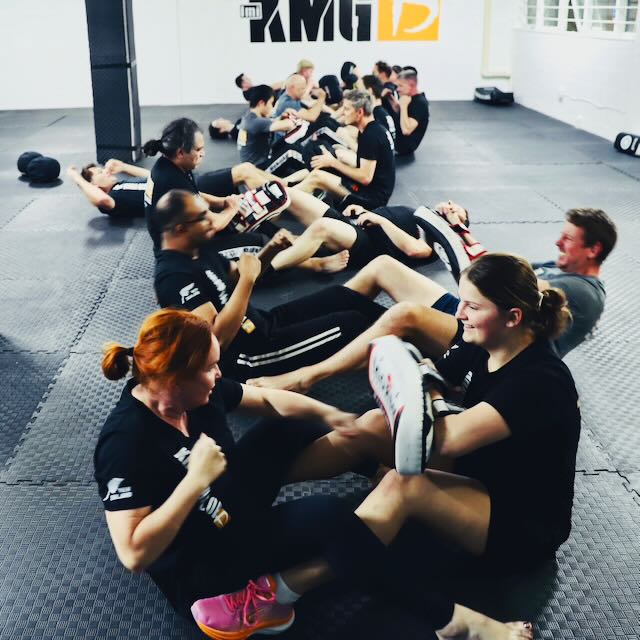
Partner conditioning drill — North Shore class, Birkenhead.
Most people don't fail at the gym — they drift away from it
The gym works. That's not the issue. Progressive resistance training, cardiovascular conditioning, body composition changes — the gym delivers all of it when used consistently. The problem is the word "consistently."
The pattern most people follow is predictable: strong start, gradual drift, full stop. They go regularly for two or three weeks. Maybe a month, maybe two. Then one session gets skipped. Then another. And once the streak is broken, re-starting requires a fresh decision — a new act of will — which becomes progressively harder to summon the longer the gap grows.
This isn't a character flaw. It's a structural problem. The gym environment is almost entirely passive — it doesn't pull you back. Nothing is tracking whether you showed up. No one is waiting for you. No one notices if you're gone. The friction of not going is lower than the friction of going, and over time, low friction wins.
Why gym motivation fades — even when you genuinely want results
Gym training places the full burden of consistency on the individual, and that burden compounds over time. You have to decide to go. You have to know what to do when you get there. You have to push yourself through it without anyone guiding the session. And you have to do all of that again, and again, indefinitely, while the initial novelty of a new routine slowly wears off.
Motivation research consistently shows that intrinsic motivation — the kind that powers new habits — is strongest in the first few weeks, when everything feels novel and progress feels obvious. After that, the returns feel smaller even when the gains are real, because your baseline has shifted. The cardio that wrecked you in week one feels routine in week six. The novelty is gone. What's left is discipline, and discipline without environmental support is a depletable resource.
There's also the planning overhead. A self-directed gym session requires you to know what you're doing — which muscle groups, which exercises, how many sets, how to progress week to week. Most people either don't know, guess, or follow a programme for a while before abandoning it when it stops feeling relevant. The gap between "I should go to the gym" and "I know exactly what I'm doing there today" is where most routines die.
What Krav Maga does differently
Krav Maga doesn't ask you to supply the motivation — the environment supplies it instead. At the North Shore classes in Birkenhead, the structure does the work that willpower usually has to do at the gym.
The specific differences that matter most for long-term consistency:
- Scheduled classes at fixed times — you commit to a time slot, not a vague intention. Saturday 8am, Monday 6:30pm, Wednesday 6:30pm. It's in the calendar. Skipping requires an active decision, not a passive drift.
- Instructor-led sessions — you don't need to know what you're doing. You show up and the session is run for you. The cognitive overhead of self-directing drops to near zero.
- Training partners — most Krav Maga drills require two people. Your partner is waiting for you. That's a real social obligation, not an abstract one. It's the single most reliable consistency mechanism in group training.
- Progressive skill development — the KMG curriculum moves through Practitioner, Graduate, and Expert levels. Every session is building toward something. You can feel yourself getting better at specific things — not just generally fitter — which gives progress a shape that's missing from most gym routines.
- Genuine session variety — the techniques, combinations, and scenarios change each week. The warm-up structure is familiar; the content is always slightly different. That keeps the novelty gradient alive far longer than a fixed gym programme does.
The shift: from "working out" to training
There's a moment most Krav Maga students describe — usually somewhere between weeks four and eight — where something changes in how they think about showing up. It stops being an obligation and becomes a default. Not because they've become more disciplined, but because the identity around it has shifted.
At the gym, you're working out. The session is a means to an end — calories burned, muscles fatigued, box ticked. The value is entirely in the outcome, which means the session itself is something to get through. That framing makes skipping easy to justify: "I'll go tomorrow." "I'll make up for it on the weekend." The session is interchangeable with any other session, or with not going at all.
With Krav Maga, you're training — and that word carries a different relationship to time and continuity. Imi Lichtenfeld, who founded the system, built it around the idea that technique develops through repetition across sessions, not within a single one. Missing a class doesn't just break a streak — it's a gap in a developing skill. You're learning a knife defence sequence. You're working on a combination you didn't have last month. The sessions connect to each other in a way that gym workouts don't.
This is why people who've struggled with gym consistency for years find themselves training Krav Maga two or three times a week without it feeling like a feat of willpower. It's not that they've changed — it's that the thing they're doing has a different relationship to identity and progress.
"I've had gym memberships three times. I lasted maybe six weeks each time. I've been doing Krav Maga for eight months and I've only missed three classes."
— Krav Maga Auckland member, North ShoreWho this pattern works best for
Not everyone struggles with the gym — but for a specific profile of person, Krav Maga solves a consistency problem that willpower alone hasn't. The people who report the clearest shift tend to share a few characteristics:
- They've joined gyms before and stopped — usually more than once
- They prefer to be told what to do in a session rather than self-directing
- They find purely physical goals (weight, measurements, aesthetics) less motivating than capability goals
- They have busy schedules and need a training format that fits a fixed slot rather than a flexible-but-vague commitment
- They respond well to social environments — to training alongside people they recognise, and to being known in the room
For many North Shore members balancing work, family, and everything else, Krav Maga's fixed timetable is the feature, not a limitation. Two sessions a week at predictable times is something a calendar can accommodate. "Get to the gym three times this week" is not.
If you're weighing up the fitness side specifically — what Krav Maga delivers physically compared to a gym — see Can Krav Maga replace the gym? and Is Krav Maga a good workout? for the detail on that question.
What people ask about consistency and Krav Maga
The gym places the full burden of consistency on the individual — you have to decide to go, plan what to do, and push yourself through it, indefinitely. Krav Maga replaces that burden with structure: fixed class times, instructor-led sessions, and training partners who are expecting you. The environment does the work that willpower usually has to do alone at the gym.
Initial motivation is useful for getting you through the door — but it isn't what keeps you coming back. The structure of Krav Maga training takes over from there. Scheduled classes remove the daily decision of whether to go. Training partners create a genuine social obligation. Skill progression gives you something concrete to come back for. Most people find the motivation question becomes irrelevant after the first few weeks because the habit forms on its own.
In Krav Maga, most drills require two people — one executing, one assisting or resisting. Your partner is physically waiting for you to show up. That's a real social obligation, not an abstract one, and it's one of the most reliable consistency mechanisms in any training environment. At the gym, you're accountable only to yourself — and that accountability is easy to renegotiate when you're tired or busy.
For people with a history of gym dropout, Krav Maga tends to produce a noticeably different pattern — not because the person changes, but because the environment is structured differently. If your gym failures came from motivation drift, lack of direction, or sessions that felt repetitive, those specific problems are addressed by Krav Maga's structure. It's not a character test — it's a better-matched format for how many people actually behave.
Most students describe a shift somewhere between weeks four and eight — around the point where they recognise faces in the room, know what to expect from a session, and start to feel capable of things they couldn't do before. At that point, showing up stops feeling like a decision and starts feeling like a default. The Essentials course is structured to get you through that early phase with clear progression and the same training group each week.
Start Something You'll Stick To
Book a trial class at our Birkenhead studio on Auckland's North Shore — no experience needed, no fitness test.
Book a Trial ClassNo experience needed. Just show up — we'll guide you from there.