What Are the Key Principles Behind Krav Maga Training?
Krav Maga is built on a specific set of principles that distinguish it from traditional martial arts — simplicity under stress, instinctive movement, simultaneous defence and counterattack, and awareness as the first line of defence. At Krav Maga Auckland, training at 47 Birkenhead Avenue on Auckland's North Shore, every class is designed around these principles through the internationally recognised Krav Maga Global (KMG) curriculum.
Most people who come to train on the North Shore — from Birkenhead, Northcote, Glenfield, Takapuna, and across the wider Auckland area — arrive without a martial arts background. What they quickly discover is that the training isn't built around athleticism or memorising complex sequences. It's built around principles that work regardless of who you are or what you're up against.
This article covers the core principles that shape every Krav Maga session — from how techniques are designed to how training prepares you for the reality of a stressful situation.
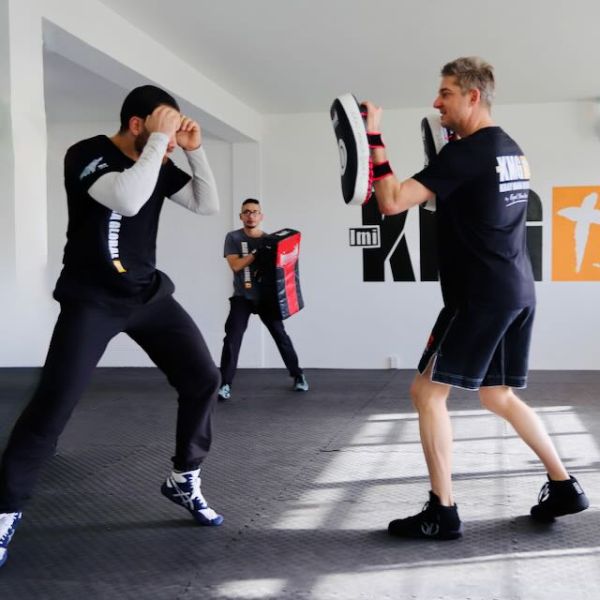
Why does Krav Maga use simple, direct techniques?
Krav Maga is built around techniques that work when you're under pressure — not when conditions are perfect. In a real confrontation, adrenaline narrows attention, fine motor control degrades, and decision-making slows. Techniques that depend on precision, timing, or complex sequences fall apart under those conditions.
The solution is deliberate simplicity. Every technique in the Krav Maga system relies on gross motor movements — large muscle groups, natural body mechanics, and direct lines of force. A beginner and an experienced practitioner can both execute the same technique effectively, because it doesn't require years of refinement to work.
This also means training time is spent developing the right responses rather than memorising elaborate systems. You're not learning a catalogue of techniques — you're building a small number of reliable responses that become instinctive under pressure.
What does it mean that Krav Maga builds on natural instincts?
Most self-defence systems ask you to override your natural reactions. Krav Maga refines them instead. When someone swings at your face, your hands come up instinctively. When you're grabbed, your body tries to create distance. These reactions are hardwired — they happen before conscious thought.
The KMG curriculum is structured to work with these instincts. Defensive movements often begin from the position your body is already moving toward, then redirect that energy into an effective response. This accelerates learning significantly: you're not fighting your own reflexes, you're training them.
It also means skills hold up better under real stress. Responses built on natural movement patterns are more accessible when adrenaline fires and deliberate thinking becomes harder.
What is simultaneous defence and counterattack?
One of the defining tactical principles of Krav Maga is that defence and counterattack happen at the same time — not in sequence. In traditional martial arts, a common pattern is block, then strike. Krav Maga collapses that sequence into a single movement: the defensive action simultaneously creates the opportunity to end the threat.
This matters practically. Every fraction of a second an attacker still has the initiative is an opportunity for another strike, another grab, or another escalation. Simultaneous action removes that window. It also changes the psychological dynamic — you're not reacting to the attacker, you're taking control of what happens next.
The principle applies across technique families, from basic strike defences to weapon scenarios. The goal is always to address the immediate danger while simultaneously moving toward resolution.
Why does Krav Maga put so much emphasis on awareness and avoidance?
The most effective self-defence is the situation that never becomes physical. Krav Maga training puts awareness and avoidance at the centre of the curriculum — not as an afterthought, but as the first line of defence. Most threats can be resolved before they escalate if you recognise them early enough.
Training covers how to read environments, identify pre-attack indicators, create distance, and position yourself advantageously. Verbal de-escalation is a skill that gets practised — how to set boundaries clearly, reduce tension, and disengage without a physical confrontation.
According to KMG founder Eyal Yanilov, awareness and avoidance are foundational to the entire system — physical techniques are the last resort, not the primary skill set. This shapes how every class at Krav Maga Auckland is structured: environmental reading and decision-making are part of every training block, not a separate topic addressed occasionally.
How does Krav Maga training prepare you for real stress?
Training in a calm gym environment only gets you partway there. Real confrontations involve fear, tunnel vision, elevated heart rate, and decision-making under pressure. Techniques that work perfectly in a controlled drill can fall apart when those factors are present.
Krav Maga addresses this through progressive stress exposure. Beginners start with controlled drills where technique is the focus. As skills develop, training introduces elements that change the environment: time pressure, movement, resistance from a training partner, scenario-based drills where the response isn't known in advance.
This isn't about making training brutal — it's about making it honest. The goal is to close the gap between how a technique performs in training and how it performs when it actually matters.
How are these principles applied at KMG North Shore Auckland?
At Krav Maga Auckland — KMG's certified club on Auckland's North Shore — every class is structured directly around these principles. The training follows the internationally recognised KMG curriculum, the same system used by certified instructors in over 60 countries. Nothing is added or omitted based on local preference — you're training the same standard that applies worldwide.
Instructor Aaron holds Expert Level 2 in the KMG system and has trained directly with Master Eyal Yanilov — the founder of Krav Maga Global — across 17+ international camps in Israel, the UK, Australia, and New Zealand. Instructor Brad holds Graduate Level 2 and completed his own KMG certification in 2019. The standard they teach comes directly from the source.
Training at 47 Birkenhead Avenue, Birkenhead — accessible from Northcote, Glenfield, Takapuna, Albany, and across the wider North Shore. Classes run three times a week: Saturday mornings (8–9am) and Monday and Wednesday evenings (6:30–7:30pm).
Most members who train here come from the North Shore — professionals, parents, shift workers, and people in their 30s, 40s, and 50s who want practical skills in an environment that takes them seriously. No prior experience is needed. Intensity and contact are scaled to where you are when you arrive.
Does Krav Maga work for people of different sizes and fitness levels?
The principles of Krav Maga are designed to work regardless of size, strength, or physical condition. Techniques are built around body mechanics, targeting, and positioning — not on requiring the defender to be physically superior to the attacker. A smaller person defending against a larger attacker is addressed explicitly in the curriculum, not treated as an edge case.
This makes Krav Maga genuinely accessible. At Krav Maga Auckland on Auckland's North Shore, most members start with no prior martial arts background. Many begin training in their 30s, 40s, or 50s. Intensity and contact are scaled to the individual — you're not expected to perform at the same level on your first session as someone who's been training for two years.
What the principles guarantee is that the techniques you're learning are built to work for you as you are now, and will remain relevant as your fitness and capability develop over time.
What People Ask About Krav Maga Principles
Traditional martial arts are often built around forms, belts, rituals, and competition rules that don't apply to real-world self-defence. Krav Maga strips all of that away and focuses only on what works under real-world conditions. There's no scoring, no uniforms, no kata — just techniques designed around real threats, trained progressively under increasing pressure. The KMG system is structured and has formal grading, but the standard is practical capability, not performance of prescribed forms.
Yes — the principles are explicitly designed for people without a martial arts background. Because Krav Maga builds on natural instincts and uses gross motor techniques, beginners often find the logic intuitive from the first session. The structured KMG curriculum introduces everything progressively, so there's no expectation of prior knowledge. Most members at Krav Maga Auckland started with zero experience.
Very much so. Situational awareness, reading body language, recognising when a situation is escalating, and knowing how to de-escalate it verbally are skills that apply constantly — not just in threatening situations. Many members at Krav Maga Auckland report that these awareness skills become the most consistently useful part of their training, even if they never need the physical techniques.
Most students notice a real shift in awareness and confidence within the first few weeks — not mastery, but a genuine change in how they carry themselves and read their environment. Building instinctive physical responses takes longer: typically three to six months of consistent training to feel genuinely reliable under pressure. The KMG curriculum is designed for this timeline, building each principle progressively so that nothing is demanded before the groundwork is in place.
Krav Maga Auckland at 47 Birkenhead Avenue, Birkenhead, is Auckland's only KMG-affiliated club and the North Shore's dedicated Krav Maga training centre. Every class follows the Krav Maga Global curriculum — the same internationally recognised system used in 60+ countries. The location is easily accessible from Northcote, Glenfield, Takapuna, Albany, and across the wider North Shore, with free parking at Highbury Mall directly opposite.
Classes run Saturday mornings (8–9am), Monday evenings (6:30–7:30pm), and Wednesday evenings (6:30–7:30pm). No experience is needed to start — most members begin with zero martial arts background.
Yes — the principles are specifically designed not to depend on physical superiority. Techniques rely on body mechanics, positioning, and targeting vulnerable areas, not on strength or size. Many women at Krav Maga Auckland train specifically because the system addresses realistic scenarios they might actually face, including situations involving a size or strength disadvantage. A dedicated women's self-defence programme is also available.
Find Out What You're Capable Of
Book your first session at Krav Maga Auckland — 47 Birkenhead Avenue, Birkenhead, North Shore. We'll guide you from there. No experience needed, no commitment beyond the first class.
Book Your First Session