Why Krav Maga Trains Knife Defence Differently
Most martial arts weren't designed around weapon threats. Krav Maga was. The training is built for unpredictability, pressure, and escape — not for competition or tradition. Knife defence at Krav Maga Auckland reflects that, with scenario-based work, pressure-tested response, and an honest acceptance that real situations don't follow rules.
If you've trained in another martial art, the way Krav Maga approaches knife defence will look unfamiliar. Different stances, different drills, different vocabulary. The reason isn't that one approach is "better" than another — it's that they're solving different problems.
This article walks through why the Krav Maga training methodology looks the way it does, especially around knife defence, and what that means if you're coming in from a different background.
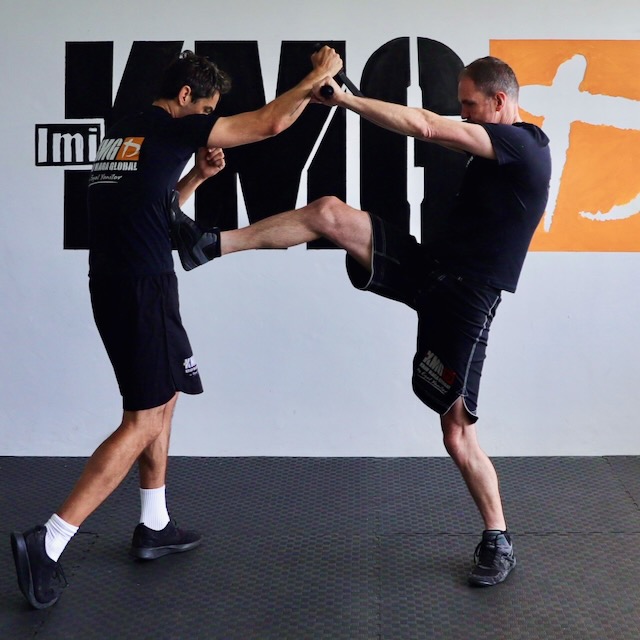
Instructor Aaron defending an overhead stab — Krav Maga Auckland.
Different systems were designed for different problems
Most martial arts were developed with a specific focus in mind — sport competition, traditional forms, one-on-one unarmed exchanges. Each builds real attributes: fitness, coordination, technical skill, discipline. None of them are wrong. But they weren't designed around modern, unpredictable threats like knives, and asking them to do that job is asking for the wrong tool.
Krav Maga was built differently. It was developed for situations the founder couldn't avoid in 1930s Europe — multiple attackers, weapons, no rules, no time. The system that came out of that history is shaped by those constraints. It's not better at competition than competition systems. It's better at the specific problem it was built to address.
Key takeaway: different systems solve different problems. Krav Maga is built for unpredictable threats, not competition or tradition.Why sport methodology doesn't transfer cleanly to knife threats
In sport-based systems, there are rules. Defined start and finish points. Both participants are unarmed. Distance is regulated. There's a referee. These constraints make the sport possible — and they're also what makes the methodology incomplete for knife situations, where none of those constraints apply.
A real knife encounter has no agreed distance, no pause to reset, no limitation on what the attacker does. The training has to reflect that, or it builds responses that work only inside the constraints they were trained under. Different systems compared for self-defence goes deeper into this trade-off at a national level — short version: sport effectiveness and self-defence effectiveness are different metrics.
Key takeaway: sport rules make sport possible — and incomplete for unrules-based situations like knife threats.How the Krav Maga training methodology works
The KMG training methodology is built around four ideas that show up in every class: awareness before contact, decision-making under uncertainty, simple direct responses that hold up under pressure, and creating an opportunity to escape rather than win an exchange. These ideas shape the curriculum, the drills, the way coaches give feedback, and how progress is measured.
For knife defence specifically, this methodology means training is integrated rather than isolated. Knife threats appear in striking drills, in partner exercises, in scenarios where the weapon isn't visible from the start. How we train knife scenarios covers the scenario side in detail — but the underlying methodology is the same one applied to every part of the training.
Key takeaway: KMG methodology is awareness, decision-making, simple responses, escape — applied to every part of training, including knife work.It's not about saying one system is better
This is the part that's worth being clear about: Krav Maga isn't claiming to be "better" than other martial arts. Different training methodologies produce different outcomes, and the right one depends on what you're training for.
"Different systems were built for different problems. The right question isn't which is better — it's which is built for what you're actually facing."
— Approach to comparing systems at Krav Maga AucklandIf your goal is competition, sport-based systems are highly effective and built for it. If your goal is tradition, traditional arts give you structure and depth that Krav Maga doesn't try to provide. If your goal is real-world self-defence — including the kinds of situations that involve weapons, pressure, and no rules — then the training methodology needs to match that environment, and that's the gap Krav Maga was built to address.
Key takeaway: which system is "right" depends on what you're training for. The honest comparison is by purpose, not by ranking.Pressure and scenarios are where the methodology shows
One of the biggest practical differences is how training is applied. In Krav Maga, techniques are pressure-tested rather than rehearsed in isolation. Scenarios introduce unpredictability rather than removing it. Students train to function when the situation isn't clear, not just when it's set up cleanly. This is where knife defence becomes more realistic — and it's where the training methodology earns its difference.
If your concern is "would I know what to do if something unpredictable happened?", the training has to reflect that unpredictability from the start. Whether this kind of training is genuinely realistic is a fair question with its own honest answer — but the methodology is at least built around the right premise.
Key takeaway: pressure-testing and scenarios are where the methodology proves itself. Without them, the difference is theoretical.Coming in from another martial art
If you've trained in another system before, you'll bring useful attributes — coordination, fitness, body awareness, comfort with partner work. All of those carry over. What might take some adjustment is the absence of forms, the lack of competition framework, and the specific way Krav Maga prioritises simple responses over complex sequences.
Most people with prior experience progress quickly through the early levels because the physical fundamentals are already there. The bigger shift is mental — moving from "what's the technique for this situation?" to "what's the simplest available response, and can I disengage from this?" That mental shift is what the curriculum is structured to build.
Key takeaway: prior martial arts experience helps. The mental shift — from technique-collecting to escape-thinking — is the bigger adjustment.Honest Questions About the Krav Maga Approach
Yes. Other systems build attributes that transfer well — coordination, body control, comfort with contact, fitness, mental discipline. What they often don't directly train is the specific methodology around weapon threats, pressure under uncertainty, and escape-focused decision-making. Those are the gaps Krav Maga is built to address.
No. The Krav Maga curriculum is designed for ordinary adults with no martial arts background. Beginners start from scratch and progress at their own pace. People with prior experience often pick up the physical side faster, but the mental approach takes the same adjustment for everyone.
No. The training also develops awareness, confidence, fitness, and general self-defence capability that applies far below the "extreme situation" threshold. Knife defence is one part of the curriculum because the methodology has to cover real-world worst cases — but most of what students gain is more general than that.
The opposite — most prior experience is an asset. The physical attributes carry over, and habits learned in any disciplined training environment transfer well. The only adjustment some experienced martial artists notice is moving from "what's the right technique" to "what's the simplest available response and how do I disengage" — that mental shift is the curriculum's main work for someone with a background.
Krav Maga Auckland runs classes at 47 Birkenhead Avenue, Birkenhead. Beginner sessions are Saturday at 9am, Monday at 6:30pm, and Wednesday at 6:30pm. Knife defence is part of the regular curriculum from the first level.
Train for what you'll actually face
One session at 47 Birkenhead Avenue, Birkenhead. Come and see what training built for the real-world problem actually looks like.
Book Your First Session