Is Knife Defence Realistic? An Honest Answer
Knife defence isn't safe, predictable, or guaranteed — and any school that tells you otherwise is selling something. Realistic training won't make you immune. It can improve your ability to recognise danger, decide quickly, and create space to get to safety. That's what "realistic" actually means.
If you're asking whether knife defence is realistic, you're probably really asking: would this actually work if it happened for real? It's a fair question, and it deserves a straight answer.
The straight answer is that there are no guarantees. Knife situations are fast, chaotic, and dangerous, and even highly trained people can be injured. Any system that promises a clean outcome against a knife is oversimplifying the reality. If it looks easy, it isn't.
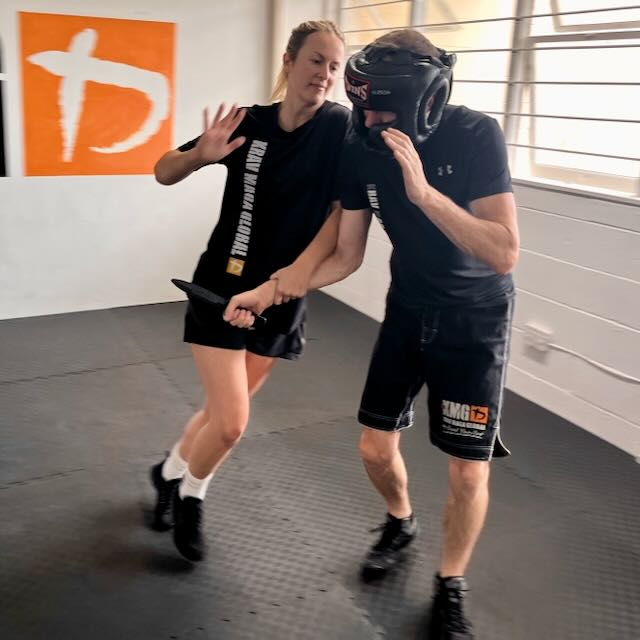
Realistic training, properly protected — Krav Maga Auckland class.
What most people get wrong about knife defence
Most people's mental picture of knife defence comes from demonstrations, movies, and highly controlled training clips. These tend to show slow, predictable attacks, clear starting positions, and clean disarms. That's not what a real situation looks like.
In a real attack, the speed is not what a beginner expects. There's not one strike — there are several, fast, in close. Distance is unclear. The situation is already in motion before you've registered what's happening. Training that ignores this builds something worse than no training at all: it builds false confidence. And false confidence in a knife situation gets people hurt.
Key takeaway: clean demonstrations create a misleading picture. Real situations are faster, messier, and already moving.What "realistic" actually means
Realistic knife defence training doesn't mean you always succeed, you avoid injury, or you execute techniques perfectly. Those outcomes can't be guaranteed and any honest instructor will tell you so. What realistic means is something more useful: you recognise danger earlier, you respond faster under pressure, you make better decisions when things escalate, and you create opportunities to disengage that you wouldn't have created untrained.
The goal of the training shifts from "winning the situation" to "getting out of it as safely as possible." That's a smaller-sounding goal. It's also the only honest one.
Key takeaway: realistic doesn't mean perfect. It means functional — earlier recognition, faster decisions, better odds of escape.So why train knife defence at all?
If there are no guarantees, a fair question is whether training is worth doing. The answer is yes, because the alternative is worse. Without training, people freeze. They react too late. They make rushed or ineffective decisions. The gap between recognising a threat and doing something about it is wide, and that gap is where most situations escalate.
Training narrows the gap. You're not learning to "beat" a knife — you're learning to stay present, respond earlier, and improve your chances of getting away. The probabilities aren't in your favour either way, but they shift, and that shift is the whole point.
"Doing nothing is also a decision — and usually the worst one."
— Approach to knife defence at Krav Maga AucklandDecision-making matters more than technique
One of the biggest misconceptions is that knife defence is about having the "right move." In practice, the bigger factor is what decision you make and when. Did you recognise the threat early? Did you create distance quickly? Did you commit to action, or did you hesitate? Good decisions made early can prevent escalation entirely. Poor decisions — even paired with sound technique — can make things worse.
This is the part of the training most beginners underestimate. They want to know "what's the move?" The honest answer is that the move only matters if you've already made the harder calls correctly. The technique matters. The decision matters more.
Key takeaway: what decision you make and when matters more than which technique you use.Where realism really develops
Realism isn't built by drilling a technique a hundred times. It's built by training in situations where the threat may not be obvious from the start, where the situation evolves, and where you have to adapt in real time. This is what scenario-based work is for, and it's where most of the realism in our curriculum lives. We've covered how scenarios are structured at Krav Maga Auckland in a separate article — short version: the knife often isn't the starting point, and learning to recognise the shift is most of the skill.
What scenario work removes is the expectation that situations will be clear or predictable. That expectation is the single biggest gap between training and reality, and closing it is what makes the training worth doing.
Key takeaway: realism is built in scenario work, not in clean drills. The skill is reading the situation, not executing the move.The legal reality is part of realism too
Realism isn't only about physical response — it's also about understanding what you're allowed to do. In New Zealand, self-defence is built around reasonable force, not retaliation. Avoidance is preferred. Escape is the priority. Any force used must be proportionate to the threat and must stop when the threat does.
Training reflects this. The aim isn't to engage longer than necessary — it's to create a chance to get away safely, and to stop when that chance is taken. If you want a fuller breakdown of the legal framework, KMG New Zealand has a dedicated article on how reasonable force is defined at a national level. Realistic training has to include the legal reality, not just the physical one.
Key takeaway: realistic training is shaped by the legal framework — proportionate, safety-focused, stops when the threat stops.So… is it realistic?
If "realistic" means guaranteed success, clean outcomes, and no risk — then no, knife defence isn't realistic. Nothing is. No system can offer that, and any system that claims to is selling fiction.
If "realistic" means improving your ability to respond under pressure, reducing how long you hesitate, and increasing your chances of getting away — then yes, it absolutely is. That's the version of realistic that's worth training for, and it's the version the KMA curriculum is built around.
Key takeaway: realistic = functional, not perfect. That's the only honest definition, and the only one worth training for.Honest Questions About Knife Defence
There are no guarantees. Knife situations are dangerous regardless of how trained you are. What training does is improve your ability to recognise danger earlier, decide faster, and create opportunities to escape that you otherwise wouldn't have. The goal is to shift the odds, not eliminate the risk.
If you can safely get away early, that's always the best option — and recognising when that's possible is part of what's trained. The harder situations are the ones where escape isn't immediately available: the distance is too short, you're cornered, or someone you're with can't move quickly. Training covers what to do in those moments too.
Yes, but they're taught within a broader context of awareness, control, and escape — not as standalone solutions. A clean disarm in a controlled drill is a useful learning tool. A clean disarm as a real-world expectation is a fantasy. The framing matters.
Yes. Beginners start with controlled drills before moving into more complex situations. The curriculum is designed for ordinary adults with no martial arts background, and knife defence is part of the beginner syllabus from the first level — taught at an appropriate pace and intensity.
Krav Maga is built around real-world threats rather than sport, which means the techniques and the training methodology are oriented toward situations that aren't clean or fair. That doesn't make it magic — no system is — but it does mean what's trained is matched to what's likely to happen. Effectiveness comes from training honestly with that match in mind.
Krav Maga Auckland runs classes at 47 Birkenhead Avenue, Birkenhead. Beginner sessions are Saturday at 9am, Monday at 6:30pm, and Wednesday at 6:30pm. Knife defence is part of the beginner curriculum from the first level.
Honest training. Real outcomes.
One session at 47 Birkenhead Avenue, Birkenhead. Come and see what realistic actually looks like in a class.
Book Your First Session