Krav Maga vs the Gym for Fitness in Auckland
For people who’ve drifted away from the gym, Krav Maga is often a better fit for getting in shape because the fitness is a byproduct of learning a real skill. At Krav Maga Auckland, classes train cardio, strength, and conditioning through structured drills with a partner — you’re engaged the whole time, the pace is set for you, and you stick with it because the training has a point.
If you’ve ever tried to get fit at the gym and quietly drifted away, you’re not the problem. Most people don’t enjoy standing in a gym working through a programme they don’t really care about — and for a lot of people in Auckland, especially on the North Shore, that’s the difference between starting and actually sticking with training.
If you’ve joined a gym, gone consistently for a few weeks, then quietly stopped — you’re not alone. For a lot of people, the issue isn’t discipline. It’s motivation. Treadmills and weight rooms are demanding in a specific way: you have to bring the structure, the pace, and the focus yourself, every single time.
Krav Maga training is built differently. The structure is already there. The pace is set. You’re working with a partner and a group, you’re learning a practical skill, and the fitness comes along for the ride.
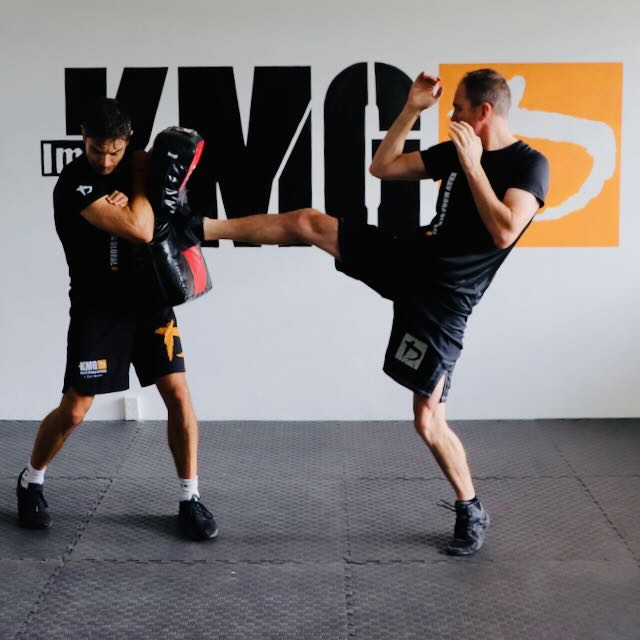
Instructor Aaron and Instructor Brad training at Krav Maga Auckland, Birkenhead.
Why does the gym stop working for so many people?
Most gym programmes ask you to be your own coach, your own scheduler, and your own motivator — and that’s where they break down. A treadmill or a weight rack is a tool. It does nothing on its own. You have to decide what to do, how hard to push, when to stop, and when to come back tomorrow. That’s a lot of decisions to make alone, three or four times a week, indefinitely.
The first few weeks usually go well. Motivation is high, the routine is fresh, and progress is visible. Then a busy week hits. One missed session becomes two. The next visit feels harder than the last one did, and the loop quietly closes.
This isn’t a willpower problem. It’s a structure problem. Solo training puts the entire weight of the habit on the individual — and most people, most of the time, don’t want to be their own personal trainer.
How is Krav Maga training different from a gym workout?
Krav Maga is a self-defence system, so every session is built around learning practical skills — not around burning calories. You’re moving with intent, reacting to a partner, drilling techniques, and working through scenarios. The fitness is a side-effect of training the skill properly.
That changes the whole feel of the session. Instead of counting reps and watching the clock, you’re engaged with what you’re doing. The instructor sets the pace, the focus shifts every few minutes, and you’re working with someone — not on a machine.
Most people end up working harder in a Krav Maga class than they would alone, and they don’t notice until afterwards. That’s the difference between training and exercising. Training is going somewhere. Exercising is just moving.
- Solo gym session — you set the pace, the structure, and the intensity
- Krav Maga class — the structure is set; you bring up to it
- Solo gym session — success is measured in reps and weight
- Krav Maga class — success is measured in capability under pressure
What does the training actually do for your fitness?
A typical Krav Maga session combines cardio, conditioning, and strength work inside the drills themselves — you don’t train them separately. Striking pads at pace builds cardiovascular conditioning. Clinching, breaking grips, and ground work build full-body strength. Reactive drills build coordination and short-burst endurance. None of it is laid out as a fitness programme, but all of it is doing the same job.
Over a few months of consistent training, most people notice the same set of changes: better cardio, more strength through the legs, hips, and core, better coordination under fatigue, and a leaner, more functional physique. The body adapts to what it’s being asked to do, and Krav Maga asks for a lot.
The companion article Is Krav Maga a good workout? goes deeper into the specific physiological demands of training. The short version: yes, it is — but the fitness gains are a consequence of training the system properly, not the goal.
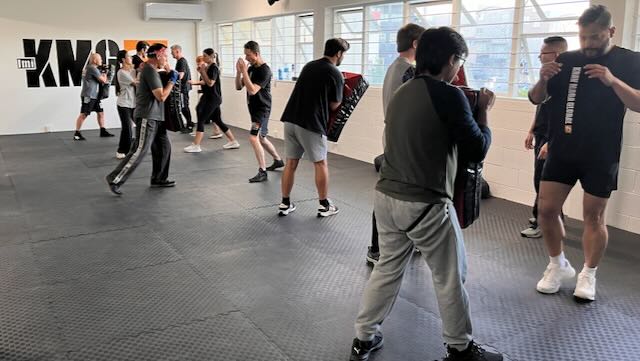
Pad drills build striking power, timing, and cardiovascular conditioning at the same time.
Why does training in a group push you further than training alone?
The single biggest difference between gym training and Krav Maga training is the group — and it’s the part that quietly drives most of the fitness results. Classes at Krav Maga Auckland mix beginners, regular members, and people working through later levels. Everyone is focused on the same drill at the same time, and the room sets the pace.
Two things happen in that environment. The first is accountability: you turn up because the class is on, not because you talked yourself into it. The second is calibration: when the person opposite you is moving with intent, you move with intent. You go a little harder than you would alone, without forcing it, because that’s the room you’re standing in.
Over weeks and months, that calibration adds up to a meaningfully higher training load than most people would ever ask of themselves on a treadmill. And because the work is done with a partner and a group, you don’t track it as effort the same way — you track it as something you did with other people.
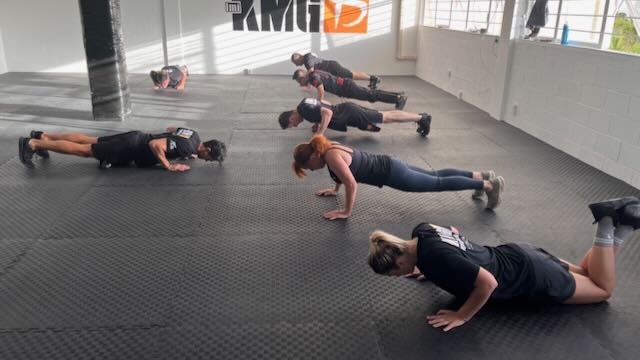
Group conditioning work — you push harder when the room pushes with you.
“I came in for self-defence. The fitness side caught me by surprise — it’s the first thing I’ve actually stuck with.”
— Krav Maga Auckland memberDo you need to already be fit to start?
You don’t need to get in shape before you start training Krav Maga — the training is designed to build that for you, from where you are. The KMG curriculum is progressive: it starts at Practitioner 1 and builds in graded steps from there. The drills scale to your level. The intensity calibrates over the first few sessions.
The system was developed in Israel by Imi Lichtenfeld and refined into the modern civilian curriculum by Eyal Yanilov, and it’s now taught to ordinary adults in over 60 countries. The curriculum doesn’t assume you arrive fit. It assumes you arrive willing to start.
Most members at Krav Maga Auckland started with no martial-arts background and no recent training. The fitness builds session by session. The skill builds at the same time. It’s the only thing the training really requires of you on day one: turn up and do what’s in front of you.
Who is Krav Maga not the right fit for?
If your goal is purely aesthetic — visible muscle, a specific physique, or competitive lifting numbers — a structured gym programme will get you there faster. Krav Maga will improve your conditioning and your body composition, but it’s not built around hypertrophy or one-rep maxes. The fitness it produces is the fitness the training needs you to have.
It’s also not the right fit if you want to train alone, on your own schedule, with no contact and no partner work. Krav Maga is partnered training. You’re working with people, every session.
And if you’re looking for sport sparring, point scoring, or competition, that’s a different world — try a BJJ, Muay Thai, or MMA gym. Krav Maga is built for self-defence outcomes, not sport. The fitness is real, but it’s the fitness of someone training a system, not the fitness of someone training to compete. Sticking with the training also takes a baseline of consistency — usually two sessions a week — for the fitness gains to compound.
What people ask about Krav Maga and fitness
Two sessions a week is the practical baseline for fitness gains to compound. At Krav Maga Auckland three sessions are available — Saturday 8am, Monday 6:30pm, and Wednesday 6:30pm — and most members train two of the three. Once a week keeps your skill ticking over but is too light to drive meaningful conditioning changes.
Most members training consistently see noticeable changes in body composition over a few months — better cardio, leaner build, more functional strength. Weight loss specifically depends on how training combines with diet, sleep, and overall activity. The training itself burns plenty of energy and builds the kind of conditioning that supports sustained fat loss, but it’s a side-effect of the training, not its purpose.
It usually feels easier in the moment because you’re engaged with the drill rather than counting reps, but the heart rate and overall workload are typically higher than a self-directed gym session of the same length. The pace is set by the class and the partner work, so you don’t notice the effort the same way. Most members find it’s the first form of training they’ve actually been able to stay consistent with.
Yes — they pair well. Strength work in the gym (squats, deadlifts, presses, core) supports striking power, clinch strength, and ground work. Cardio at the gym builds the engine that Krav Maga draws on under pressure. Two Krav Maga sessions a week plus one or two gym sessions is a strong combination for people who want both capability and traditional strength gains.
Krav Maga Auckland trains at 47 Birkenhead Avenue, Birkenhead, on Auckland’s North Shore. Beginner-friendly sessions run Saturday 8am, Monday 6:30pm, and Wednesday 6:30pm. You can book a first session through the trial booking page — the instructor will guide you through what to expect before you arrive.
See the Difference for Yourself
The difference is hard to understand from the outside. It becomes obvious within the first session.
Book Your First SessionNo experience needed. We’ll guide you from there.