How to Choose a Self-Defence Class: What Actually Matters
The three things that actually matter when choosing a self-defence class are instructor certification, curriculum structure, and whether the training is built for real situations rather than sport rules. Everything else — location, price, class size — matters only after those three are satisfied. This guide walks through each in plain terms, so you can evaluate any school honestly, including this one.
There are a lot of self-defence options in Auckland. Krav Maga, BJJ, boxing, MMA, women's self-defence workshops, community centre courses. Some are excellent. Some are dressed-up fitness classes with a self-defence label. A few are built on techniques that look convincing in a controlled environment but fall apart when there's actual pressure.
I've been teaching Krav Maga since 2010 — first in London, then on the North Shore from 2015. I have a view on what makes training useful and what doesn't. But more importantly, there are objective criteria you can apply to any school, including mine, that will tell you most of what you need to know before you step in the door.
That's what this guide covers.
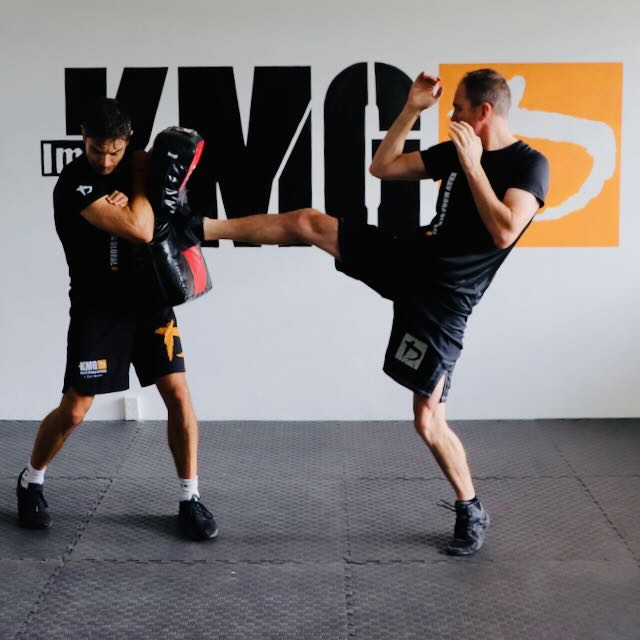
Instructor Aaron (E2) and Instructor Brad (G2) at Krav Maga Auckland, 47 Birkenhead Avenue, Birkenhead.
Why the label "self-defence" doesn't tell you much
Any class can call itself self-defence — the term isn't regulated, and the range of what it covers is enormous. A six-week women's safety workshop and a two-year Krav Maga training programme are both "self-defence." A kickboxing gym that adds a few grab defences to its timetable is "self-defence." So is an instructor teaching from an online certification they completed last month.
This isn't a criticism of any particular format — short workshops have genuine value, and combat sports have real transfer to self-protection. The problem is that "self-defence" as a category tells you almost nothing about what you'll learn, how well it transfers under pressure, or whether the instruction is any good.
The label is a starting point. What follows is what to look at next.
1. Is the instructor formally certified — and by whom?
Instructor certification is the single most useful filter, and it's easy to verify if you ask the right question. Not "are you qualified?" — almost everyone will say yes — but "what organisation certified you, and when?"
A credible answer names a recognised international body with a verifiable standard. In Krav Maga, the main one is Krav Maga Global (KMG), which runs the internationally standardised curriculum developed by Master Eyal Yanilov — the most senior student of Imi Lichtenfeld, the founder of Krav Maga. KMG certification requires passing a formal instructor examination, not just attending a training programme. Other martial arts have equivalent governing bodies with their own standards.
A vague answer — "I've trained for 20 years," "I'm self-taught," "I have my own system" — isn't necessarily dishonest, but it means there's no external accountability for what's being taught. The techniques might be solid. They might not be. You have no way to verify it.
At Krav Maga Auckland, both instructors hold formal KMG certification. I completed instructor certification in 2010 and hold Expert Level 2 — the result of 15+ years of teaching and 17 international camps with the senior KMG training team. Instructor Brad certified through the KMG General Instructor Course in November 2019. You can verify both on the instructor page.
2. Does the curriculum have a clear structure and progression?
Good self-defence training builds skills in a deliberate order — not because it's nice to have a plan, but because the order matters for how the techniques actually work together under pressure.
If you learn a defence against a grab before you've internalised a basic striking response, the grab defence becomes the thing you're reaching for in every situation — including ones where getting away fast would serve you better. If you drill techniques in isolation without scenario integration, those techniques live in a mental compartment that often doesn't open when the situation is real and fast.
The KMG curriculum used at Krav Maga Auckland has a clear civilian progression — P levels (beginner), G levels (intermediate), E levels (advanced) — with each level building on the previous one. The foundations are taught in the right order: awareness and de-escalation first, basic strikes next, defences against the most common threats once the foundation is in place. You can read a detailed breakdown in what you actually learn in Krav Maga.
What this means in practice is that a beginner who joins the regular class isn't lost — they're seeing material they'll encounter again at their own level, with increasing complexity. And the Essentials course gives first-timers a structured six-session entry point before joining the main class.
3. Is the training built for real situations, or for sport?
Combat sports and self-defence systems train differently because they're preparing for different things — and the difference matters more than most people realise.
In a sport context, you train with rules, a known opponent, a referee, and an agreed-upon framework for what counts as winning. That's not a criticism — sport contexts produce excellent athletes and genuinely useful skills. But the rules of a boxing match or a BJJ tournament are part of what makes that training work. Strip the rules out and some of those skills transfer well; others don't.
Self-defence training that's actually built for real situations trains against different variables: a threat you didn't see coming, a size and strength differential, more than one person, a weapon, a confined space. The goal isn't to win — it's to not be a victim of the situation. That usually means getting out, not continuing to engage.
The KMG system has no competitive component. Techniques are selected because they work under real conditions — when you're surprised, when adrenaline is present, when the other person doesn't comply with what they're supposed to do. You can read more about how that translates in training in how safety works in Krav Maga training.
"The teaching curriculum is very structured, organised and logical. Very practical, realistic and highly applicable — a genuine self-defence system."
— Victor4. Does the training environment match your actual goals?
Most people choosing a self-defence class aren't looking to become fighters — they want to feel less exposed, to know that if something happened they wouldn't freeze, to carry themselves differently in situations that currently make them uneasy. That's a reasonable goal, and the right training environment is one that treats it seriously.
Watch how a school handles beginners before you commit. A room full of people with years of experience, where beginners are just expected to keep up, isn't the right entry point for most adults starting from zero. The skills are harder to absorb when you're just trying to survive the session. Technique picked up under that kind of pressure tends to be imprecise and hard to repeat.
Equally, a class that's too protective — where nothing is ever difficult, no one ever gets their balance tested, contact is entirely absent — produces a false sense of capability. At some point, the training has to introduce pressure, because pressure is the context the skills need to work in.
The balance at Krav Maga Auckland is deliberate: beginners get a structured entry point through the Essentials course, partner drills are calibrated to experience level, and intensity increases as you get more comfortable with the foundations. No ego, no gym culture — but real training.
"I've never been to any martial art classes before and with a bit of nervousness I attended my first class. I was amazed how friendly but professional the instructors are — other students are just like you and me."
— Chris5. Can you verify the school's standards independently?
A school affiliated with a recognised international organisation can be verified — the curriculum is standardised, the instructor grade is on record, and there's accountability beyond the school's own marketing. That matters, because it means the claims on the website are checkable rather than just claims.
KMG affiliation works this way. The curriculum is the same across 60+ countries. Instructor grades are earned through formal examination. If you train to a particular level here and move to a KMG school abroad, the material carries. That's not a nice feature — it's evidence that the standard is real rather than self-defined.
By contrast, a school that's unaffiliated with any governing body is self-certified. The instruction may be excellent. But there's no independent standard to compare it against, and you're taking that on faith.
For a more detailed comparison of what to look for when choosing between Krav Maga schools specifically, see which Krav Maga school is right for adults who've never trained before.
"This is an amazing Krav school — linked in with the worldwide KMG network, so you can train anywhere. Fantastic instructors and group of people. Really valuable self-defence skills that are relatively easy to pick up."
— CamWhat about location, price, and schedule?
These factors matter, but only after the first three are satisfied. There's no point committing to a school close to home if the instruction isn't credible, or choosing the cheapest option if you're going to quit in two months because the training doesn't suit you.
That said — once you've found a school that meets the quality criteria, location and schedule become real. Consistency is what builds actual skill. A school that's twenty minutes away and has three session times per week is more useful than the best school in the country if you can only get there once a month.
Krav Maga Auckland runs classes on Saturday mornings (8:00–9:00am), Monday evenings (6:30–7:30pm), and Wednesday evenings (6:30–8:00pm for P2+ students). All at 47 Birkenhead Avenue, Birkenhead, with free parking at Highbury Mall directly opposite. Full details on the North Shore training page.
What People Ask When Choosing a Self-Defence Class
They're built for different things. BJJ and boxing are combat sports — excellent for fitness, technique, and building real resilience, but developed within rule sets that don't exist in a self-defence scenario. Krav Maga is designed specifically for real situations without rules, where the goal is to stop the threat and get away rather than to win a contest. Neither is universally better; the right question is what you're training for. If the answer is real-world self-protection, Krav Maga is the more direct route.
Ask which international body certified them, what grade they hold, and when they certified. A credible answer is specific: "KMG Expert Level 2, certified 2010" or "IBJJF certified black belt." Vague answers — "I've trained for years," "I have extensive experience," "I developed my own system" — aren't disqualifying, but they mean there's no external standard to verify. In Krav Maga specifically, Krav Maga Global (KMG) is the main internationally recognised certifying body.
No. At Krav Maga Auckland, the majority of new students start with ordinary fitness levels and no martial arts background. The Essentials course is structured specifically for that starting point — you'll work hard, but at an intensity that's calibrated to where you are, not where experienced students are. Fitness tends to improve as a byproduct of training rather than as a prerequisite for it.
The KMG curriculum is designed so the most useful core skills come early. Most students notice a meaningful shift in awareness and confidence within the first four to six weeks of regular training — well before they'd describe themselves as trained. The first formal level (P1) takes most people around four to six months at two sessions per week. Real proficiency is a longer arc, but you don't have to wait years to feel a genuine difference.
A good workshop gives you a handful of high-value principles and some direct experience of training under light pressure — genuinely useful if it's well run. Ongoing training builds those principles into muscle memory through repetition over time, integrates them under increasing pressure, and develops the awareness habits that tend to matter as much as any physical technique. The gap between "I know about this" and "I can do this when it counts" is where consistent training lives.
Krav Maga Auckland trains at 47 Birkenhead Avenue, Birkenhead — down the external staircase to the right of the Superette. Classes run Saturday 8:00–9:00am, Monday 6:30–7:30pm, and Wednesday 6:30–7:30pm (extending to 8:00pm for P2+ students). Free parking at Highbury Mall directly opposite. Book your first session on the North Shore training page or call 027 214 9461.
Find Out What You're Capable Of
Book your first session — we'll guide you from there.
Book Your First SessionNo experience needed. No commitment beyond the first class.