The Krav Maga Front Kick: Why This Basic Strike Works in Real Self-Defence
The front kick — called the "regular kick" in Krav Maga — is one of the first striking tools taught in the KMG curriculum. It creates distance, targets vulnerable areas like the groin and knee, and sets up follow-up strikes or escape. At Krav Maga Auckland, Instructor Aaron and Instructor Brad drill it from the very first session.
If you've watched someone train in Krav Maga, you've probably noticed how often the front kick appears — not as a showy high kick, but as a direct, short, targeted strike aimed at the lower body. That's not an accident.
This article explains what makes the front kick effective in real self-defence, how it's taught at Krav Maga Auckland, where it fits into the broader KMG system, and what beginners can expect when they first learn it.
Why does Krav Maga use the front kick so much?
The front kick is prioritised in Krav Maga because it solves the most urgent problem in a real assault: distance. Most street attacks happen at very close range — grabbing distance or closer. A kick keeps your attacker's body away from yours while you're striking back, which is exactly what you need in the first seconds of an incident.
Flashy high kicks look impressive, but in a real-world situation — uneven ground, shoes, stress, a moving attacker — they're slow, unstable, and easy to counter. The front kick travels a short distance, stays low, and targets areas that don't require precision: the groin, the stomach, the inside of the knee. In Krav Maga terms, this is the principle of "simultaneous defence and attack" — you're not waiting until you're safe to counter. You're creating safety by counterattacking immediately.
In a training context, it's also one of the safest techniques to drill with a partner. The kick is controlled, the target pads are easy to hold, and the mechanics can be developed quickly even for complete beginners.
What makes a front kick "Krav Maga" rather than a martial arts kick?
The Krav Maga front kick differs from its counterpart in Karate or Taekwondo not in shape, but in intent and target selection. A Karate front kick (mae geri) aims to score a point with form and control. A KMG front kick aims to hurt a specific vulnerable area quickly and without rules.
In Krav Maga Global's curriculum — developed and maintained by Eyal Yanilov — techniques are evaluated against one question: does this work against a non-cooperative, aggressive attacker in real conditions? High front kicks fail that test most of the time. Low front kicks targeting the groin or kneecap pass it consistently.
This is why KMG instructors spend very little time on kick form for its own sake. The training focus is on the outcome: did you create distance, did you hit the target, and did you buy time to escape or follow up?
How is the front kick actually executed in KMG training?
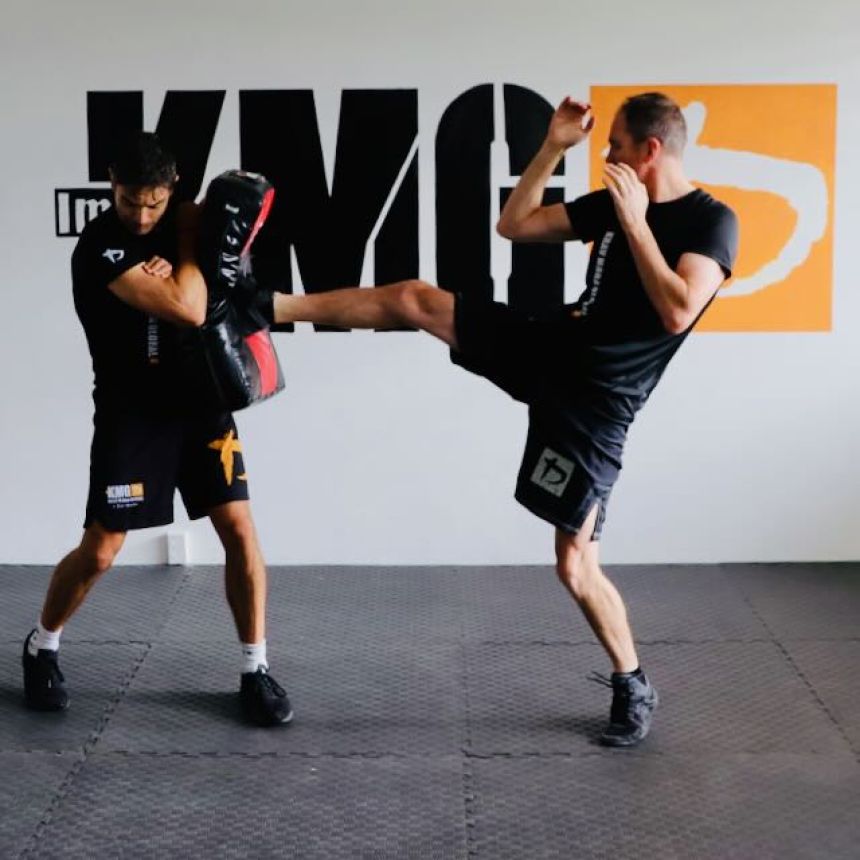
The KMG front kick is a three-phase movement: chamber, drive, and recoil — executed fast enough that the three phases blur into one. Here's how it breaks down:
- Chamber: The knee lifts forward and upward, loading the power for the strike. This phase also signals your body position to your hips.
- Drive: The leg extends forward with hip rotation behind it. The striking surface is the ball of the foot or the heel — the ball of the foot for a more penetrating strike at closer range, the heel when you need raw push force.
- Recoil: The leg returns to a strong base stance immediately. Leaving the leg extended makes you easy to grab and pull.
Instructor Aaron demonstrates the regular front kick — chamber, drive, and recoil — with live application on pads.
When targeting the groin, the trajectory is upward (scooping). When targeting the midsection or knee, the trajectory is straight forward. When you need to push an attacker back and create space, you drive through with your heel and use your hip extension for maximum push force.
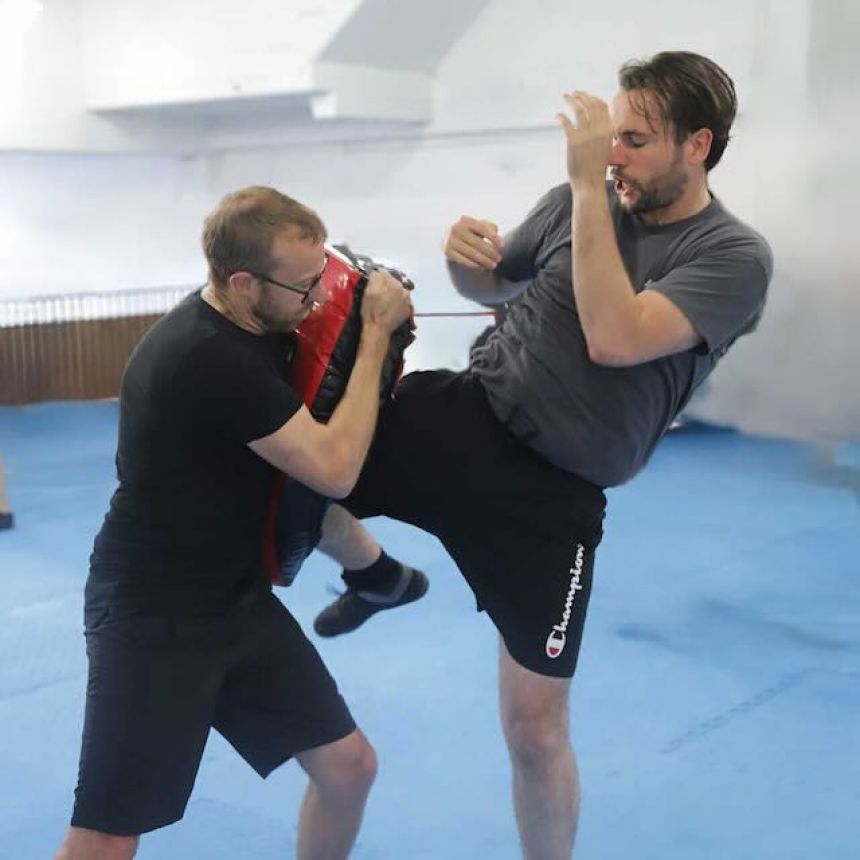
In early sessions at Krav Maga Auckland, this is drilled on focus mitts held by a training partner — slowly at first to ingrain the pattern, then faster as coordination develops. Most beginners can execute a functional front kick within their first few classes. Refinement takes longer, but functionality comes quickly.
Where does the front kick fit in a real self-defence scenario?
In a real self-defence scenario, the front kick almost never appears on its own — it's a tool within a sequence. The most common uses are:
- Opening counterattack: If someone grabs or charges, a front kick to the groin or midsection is often the first weapon you can deploy at that range.
- Distance creator: A strong push kick (heel, straight drive) resets the range between you and an attacker, giving you time to run, to look for an exit, or to set up a follow-up if escape isn't possible.
- Combination opener: A front kick to the groin bends the attacker forward and brings their head down — setting up an elbow strike, knee strike, or headlock. In KMG training this is drilled as a specific combination from the P-level curriculum.
The wider point — one of the core principles Eyal Yanilov built into the KMG system — is that techniques chain together. The front kick earns its place in the toolkit partly because of what it enables next, not just what it does on contact.
What will a beginner experience learning the front kick at KMG?
If you've never thrown a front kick before, expect your first few attempts to feel awkward — not because the technique is hard, but because using your hips effectively takes a few repetitions to click. Most beginners throw the first kick from the knee only, which produces a weak, slow strike. Once the hip connection is there, the power difference is immediate and obvious.
At Krav Maga Auckland, Instructor Aaron and Instructor Brad introduce the front kick early in the Krav Maga Essentials course — the structured four-week onboarding that all new members go through as part of their first month. The Essentials framework introduces the front kick alongside other foundational tools: the hammer fist, the palm strike, and basic defensive movements.
You don't need flexibility, prior martial arts experience, or particular fitness to learn it. You do need patience with the hip mechanics in the early reps. By the end of your first month, the pattern is usually solid enough to drill with a training partner at pace.
Classes run at 47 Birkenhead Avenue, Birkenhead, on the North Shore: Saturday mornings (8:00–9:00 am), Monday evenings (6:30 pm), and Wednesday evenings (6:30 pm).
What People Ask About the Krav Maga Front Kick
Yes — the front kick is one of the most effective tools in the KMG curriculum for women precisely because it doesn't rely on upper body strength. Leg power is proportionally greater than arm strength for most people, and targeting the groin is equally effective regardless of the attacker's size. In women's self-defence training at Krav Maga Auckland, the front kick is introduced alongside awareness training and close-range escapes — it's a practical, reliable counterattack option.
No. The Krav Maga front kick targets the groin, midsection, and knee — all low targets that don't require flexibility. Krav Maga specifically avoids high kicks for exactly this reason: head-height kicks require significant flexibility and balance, and under real-world conditions they're slow and easy to counter. The front kick stays at waist height or below, which means it's immediately accessible to beginners regardless of their current flexibility.
Most students can execute a functional front kick within their first two or three classes — the basic pattern is simple. Developing reliable power, fast recoil, and the ability to chain it into combinations takes longer: typically four to eight weeks of regular training (two to three classes per week). Competency in the kick as a combination-opener — setting up an elbow or knee strike — comes in the first month of the Essentials course at KMA.
In KMG terminology, the "regular kick" or "front kick" is the standard front kick targeting the groin, midsection, or knee with the ball of the foot. A push kick emphasises straight-line drive through the heel, used specifically to create distance rather than to strike a vulnerable target. Both use the same chamber-drive-recoil mechanics — the difference is intent and striking surface. The push kick is effective against someone closing the distance; the front kick is the preferred choice when you need to hit a specific target and cause pain quickly.
Krav Maga Auckland runs classes at 47 Birkenhead Avenue, Birkenhead, on Auckland's North Shore. Classes are held Saturday mornings (8:00–9:00 am), Monday evenings (6:30–7:30 pm), and Wednesday evenings (6:30–8:00 pm). Instructor Aaron Moore (KMG Expert Level 2) and Instructor Brad (KMG Graduate Level 2) run all sessions. You can book a trial class to attend a session and see if training is right for you.
Yes, significantly. In Karate and Taekwondo, the front kick (mae geri or ap chagi) is typically executed to score points under competition rules — which means targeting the torso, with form and control as the measure of success. In Krav Maga, the same kick is directed at the groin or knee — targets that are explicitly banned in sport competition precisely because they're so effective. Krav Maga also emphasises immediate recoil to maintain balance and transition into follow-up action, rather than holding the extended position that's common in martial arts demonstrations.
Find Out What You're Capable Of
Book your first session — we'll guide you from there. No experience needed.
Book Your First Session