Is Krav Maga Appropriate for Professional or Workplace Safety Training?
Krav Maga can be appropriate for professional or workplace safety training when it is taught as a prevention-first system — focused on awareness, de-escalation, positioning, personal safety, and controlled disengagement rather than aggression. For public-facing, healthcare, education, retail, and other high-stress roles, that makes it far more relevant than sport-based training or generic theory-only safety sessions.
In many professional settings, safety challenges are less about physical confrontation and more about managing risk, communication, and personal boundaries. For people working in public-facing or high-stress roles, the most appropriate training is practical, proportionate, and focused on prevention rather than force.
That is exactly where Krav Maga can fit — provided it is delivered responsibly, with the realities of workplace behaviour, legal obligations, and duty of care in mind.
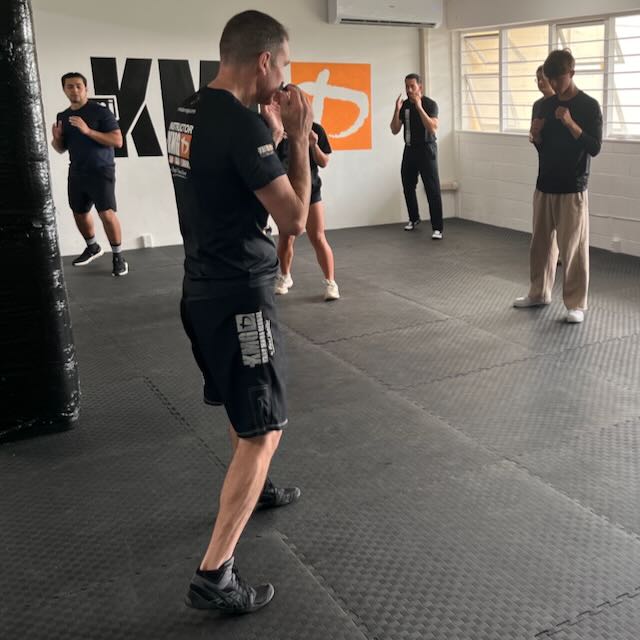
Instructor-led practical training at Krav Maga Auckland, Birkenhead.
Why workplace safety training needs a different emphasis
Workplace safety training is not the same thing as combat training. In most professional environments, the goal is not to dominate a confrontation. It is to recognise risk early, stay calm, protect yourself and others, avoid escalation, and, if necessary, disengage safely while staying inside professional and legal boundaries.
That matters because many workplace incidents begin in ordinary interactions — a patient becoming agitated, a customer becoming verbally aggressive, a meeting shifting into intimidation, or a person invading personal space in a way that feels wrong before it becomes overtly physical. Training that starts at the point of "fight back" is often already too late for real workplace use.
What professionals usually need is a framework: how to read behaviour, how to manage distance, how to communicate clearly under pressure, and how to respond proportionately if a situation crosses the line.
Key takeaway: Good workplace safety training starts before the physical moment. Prevention, positioning, and de-escalation do most of the work.Why Krav Maga can be appropriate in a workplace context
Krav Maga can suit professional environments because it is built around real situations, not competition. It places strong emphasis on situational awareness, decision-making, and de-escalation. Participants learn how to recognise early warning signs, manage distance and positioning, and respond in ways that prioritise safety and control.
That makes it particularly relevant for workplaces where employees need to remain calm, professional, and aware of their responsibilities even when something becomes difficult. Systems that focus purely on sport, dominance, or winning an exchange tend to translate poorly into those environments. The behavioural and legal expectations are different.
When physical techniques are introduced in Krav Maga, they are most useful when framed around self-protection and disengagement rather than escalation. In a workplace setting, that is usually the only frame that makes sense.
Key takeaway: Krav Maga is appropriate for workplace safety when it is taught as a practical safety framework — not as fight training.What parts of Krav Maga are most useful for staff?
The most valuable elements are often the least dramatic ones. In workplace sessions, the skills that tend to matter most are not flashy techniques. They are the ones people are most likely to use:
- reading early warning signs before behaviour escalates
- using tone, language, and body position to de-escalate
- maintaining safer positioning in rooms, reception spaces, or consultation settings
- protecting exits and creating space for yourself or colleagues
- using simple breakaway skills if someone grabs, blocks, or crowds you
- understanding proportional response and when disengagement is the goal
These are the skills that translate well into healthcare, allied health, education, hospitality, retail, and other public-facing roles. They are practical, trainable, and relevant without requiring a confrontational mindset or prior experience.
Key takeaway: The workplace value of Krav Maga is usually in awareness, de-escalation, positioning, and breakaway options — not in force-heavy techniques.A real local example: the Takapuna Health session
A good example of this in practice is the workplace session Krav Maga Auckland ran for Takapuna Health. The workshop was tailored for allied health staff dealing with difficult patient behaviour — a challenge that is common, real, and often under-addressed in conventional workplace training.
The session focused on situational awareness, verbal de-escalation, physical positioning in consultation spaces, and practical breakaway skills. It was adapted throughout for a mixed group, and the emphasis was on practical options staff could use immediately in their working environment — not generic theory and not unrealistic "fight back" messaging.
Takapuna Health — allied health team session
Around 12 staff attended a tailored two-hour session focused on difficult patient behaviour, de-escalation, positioning, and practical breakaway skills in a clinical environment. If you want the full workshop outline and team feedback, the Workplace Workshops page has the detailed references and testimonials.
"Aaron was fantastic for our group self-defence session. Very informative and fun — the whole team felt very empowered."
— Samantha, Practice Manager"I found the class super helpful and informative. Would recommend to anyone and everyone — felt completely supported throughout."
— Marnie, Takapuna HealthDoes it work for different industries and staff types?
Yes — one of the strongest features of Krav Maga in a workplace setting is adaptability. Training can be scaled to suit different roles, physical abilities, and comfort levels. That matters because a healthcare team, a retail floor team, a school staff group, and a lone-worker service team do not face exactly the same risks.
Well-taught workplace training should reflect that. The core principles stay consistent, but the scenarios, language, and priorities shift depending on the environment. In some settings, the emphasis is on consultation-room positioning and difficult patient behaviour. In others, it is customer-facing aggression, lone-worker awareness, or protecting colleagues while maintaining professional boundaries.
This is also why a tailored workshop usually makes more sense than trying to map a general class directly onto a professional environment. Context matters.
Key takeaway: Krav Maga is most workplace-appropriate when the training is tailored to the actual environment staff work in.What about workplace expectations, policies, and duty of care?
This is where delivery quality matters most. In professional settings, employees need options that align with workplace expectations, internal policies, and duty of care obligations. The training has to reinforce calm decision-making, proportionate behaviour, and clear boundaries — not encourage escalation or a "take control by force" mindset.
That is one reason the broader Krav Maga framework can fit well when taught responsibly: awareness first, de-escalation where possible, controlled action only where necessary, then disengagement. For organisations, that sequence is far more defensible and useful than any training built around physical dominance.
If the underlying teaching philosophy matters to you, our approach to training explains how these priorities sit at the centre of every session.
Key takeaway: Workplace-relevant Krav Maga must sit inside a clear legal, ethical, and professional framework — otherwise it misses the point.So is Krav Maga appropriate for workplace safety training?
Yes — in the right format, for the right purpose. Krav Maga can be highly appropriate for professional or workplace safety training because it combines awareness, de-escalation, positioning, controlled responses, and practical breakaway options in a way that reflects real-world risk.
It is not appropriate if what is being offered is essentially fight training repackaged as workplace safety. But when taught responsibly — and tailored to the situations staff actually face — it can provide a practical framework that builds confidence, improves decision-making, and gives people useful options under pressure.
For organisations or individuals looking for workplace-relevant safety training, that combination is often exactly what is missing.
And for those training on the North Shore, Krav Maga Auckland's approach already reflects that emphasis on practical decision-making and controlled responses in professional environments.
Key takeaway: Krav Maga is appropriate for workplace safety training when it is prevention-first, tailored, and grounded in professional reality.Common Questions
What People Ask About Workplace Safety Training
Not when it is taught properly for workplace use. In that context, the emphasis is on awareness, de-escalation, positioning, personal safety, and controlled disengagement. The goal is not aggression. It is giving staff practical options that fit a professional environment and help them stay safe without escalating situations unnecessarily.
It is especially relevant for healthcare, allied health, education, retail, hospitality, transport, social services, community-facing roles, and any workplace where staff regularly deal with the public, difficult behaviour, or unpredictable interactions. The more public-facing or emotionally charged the environment, the more useful practical de-escalation and personal safety training tends to be.
No. Workplace sessions should be built for ordinary working adults, not athletes. Good delivery adapts the content to mixed fitness levels, mixed confidence levels, and different physical capabilities. The point is practical safety skill, not proving toughness.
Typically: awareness and early recognition, verbal de-escalation, positioning in rooms or customer-facing spaces, boundary-setting, safe disengagement, and simple breakaway options if physical contact happens. The Workplace Workshops page is the best place to see how that is framed at Krav Maga Auckland.
The full local reference is on the Workplace Workshops page. That page includes the Takapuna Health session summary, what was covered, and the team feedback, along with the enquiry pathway if you want to discuss a tailored workshop for your organisation.
Krav Maga Auckland · Workplace Workshops
See How a Workplace Workshop Could Work for Your Team
View what's covered, see the Takapuna Health example, and enquire about a tailored session for your organisation.
View Workplace WorkshopsTailored sessions in Birkenhead · Evening and weekend options available